


Page 114 - Forbes - USA (February 2018)
P. 114
THE INVESTMENT GUIDE

           REENGINEER YOUR RETIREMENT  | SECOND ACTS


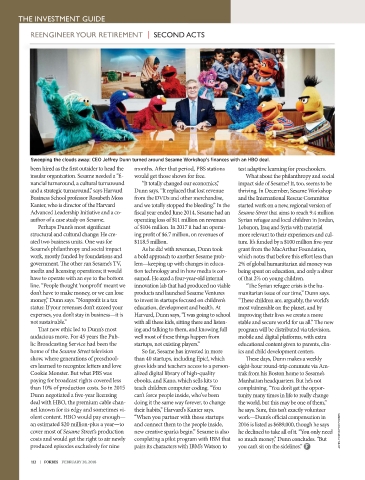
           Sweeping the clouds away: CEO Jeffrey Dunn turned around Sesame Workshop’s finances with an HBO deal.


           been hired as the first outsider to head the   months. After that period, PBS stations   test adaptive learning for preschoolers.

           insular organization. Sesame needed a “fi -  would get those shows for free.   What about the philanthropy and social
           nancial turnaround, a cultural turnaround   “It totally changed our economics,”   impact side of Sesame? It, too, seems to be
           and a strategic turnaround,” says Harvard   Dunn says. “It replaced that lost revenue   thriving. In December, Sesame Workshop
           Business School professor Rosabeth Moss   from the DVDs and other merchandise,   and the International Rescue Committee
           Kanter, who is director of the Harvard   and we totally stopped the bleeding.” In the   started work on a new, regional version of

           Advanced Leadership Initiative and a co-  fiscal year ended June 2014, Sesame had an   Sesame Street  that aims to reach 9.4 million
           author of a case study on Sesame.   operating loss of $11 million on revenues   Syrian refugee and local children in Jordan,
             Perhaps Dunn’s most signifi cant   of $104 million. In 2017 it had an operat-  Lebanon, Iraq and Syria with material

           structural and cultural change: He cre-  ing profit of $6.7 million, on revenues of   more relevant to their experiences and cul-
           ated two business units. One was for   $118.5 million.           ture. It’s funded by a $100 million fi ve-year
           Sesame’s philanthropy and social impact   As he did with revenues, Dunn took   grant from the MacArthur Foundation,

           work, mostly funded by foundations and   a bold approach to another Sesame prob-  which notes that before this effort less than
           government. The other ran Sesame’s TV,   lem—keeping up with changes in educa-  2% of global humanitarian aid money was

           media and licensing operations; it would   tion technology and in how media is con-  being spent on education, and only a sliver
           have to operate with an eye to the bottom   sumed. He axed a four-year-old internal   of that 2% on young children.

           line. “People thought ‘nonprofit’ meant we   innovation lab that had produced no viable   “The Syrian refugee crisis is the hu-

           don’t have to make money, or we can lose   products and launched Sesame Ventures   manitarian issue of our time,” Dunn says.
           money,” Dunn says. “Nonprofit is a tax   to invest in startups focused on children’s   “These children are, arguably, the world’s


           status: If your revenues don’t exceed your   education, development and health. At   most vulnerable on the planet, and by
           expenses, you don’t stay in business—it is   Harvard, Dunn says, “I was going to school   improving their lives we create a more
           not sustainable.”               with all these kids, sitting there and listen-  stable and secure world for us all.” Th e new
             That new ethic led to Dunn’s most   ing and talking to them, and knowing full   program will be distributed via television,

           audacious move. For 45 years the Pub-  well most of these things happen from   mobile and digital platforms, with extra
           lic Broadcasting Service had been the   startups, not existing players.”  educational content given to parents, clin-
           home of the Sesame Street television   So far, Sesame has invested in more   ics and child development centers.

           show, where generations of preschool-  than 40 startups, including Epic!, which   These days, Dunn makes a weekly
           ers learned to recognize letters and love   gives kids and teachers access to a person-  eight-hour round-trip commute via Am-
           Cookie Monster. But what PBS was   alized digital library of high-quality   trak from his Boston home to Sesame’s
           paying for broadcast rights covered less     ebooks, and Kano, which sells kits to   Manhattan headquarters. But he’s not
           than 10% of production costs. So in 2015   teach children computer coding. “You   complaining. “You don’t get the oppor-
           Dunn negotiated a fi ve-year licensing   can’t force people inside, who’ve been   tunity many times in life to really change
           deal with HBO, the premium cable chan-  doing it the same way forever, to change   the world, but this may be one of them,”
           nel known for its edgy and sometimes vi-  their habits,’’ Harvard’s Kanter says.   he says. Sure, this isn’t exactly volunteer
           olent content. HBO would pay enough —  “When you partner with those startups   work—Dunn’s offi  cial compensation in
           an estimated $20 million-plus a year—to   and connect them to the people inside,   2016 is listed as $689,000, though he says
           cover most of Sesame Street’s production   new creative sparks begin.” Sesame is also   he declined to take all of it. “You only need  JAMEL TOPPIN FOR FORBES
           costs and would get the right to air newly   completing a pilot program with IBM that   so much money,’’ Dunn concludes. “But
           produced episodes exclusively for nine   pairs its characters with IBM’s Watson to   you can’t sit on the sidelines.” F


           112     |     FORBES     FEBRUARY 28, 2018

