


Page 50 - Amphibian
P. 50
Continued from previous page

        Newt and salamander assortment                                                                “EYE OF NEWT”
                                                                                                      The three witches in
        Newts and salamanders belong to a smaller group of amphibians than frogs and                  Shakespeare’s Macbeth
                                                                                                      thought this was a
        toads – there are only about 360 species. Most live in cool, temperate areas of               necessity in their brew.
                               Europe, North America, China, and Japan, but one                       “Newt” comes from the
                                 group lives in tropical parts of South America.                      Anglo-Saxon “efete,”
                                   Adapted to a variety of habitats, they climb trees                 while “an ewt” became
                                                                                                      “a newt” in Middle
                                     and shrubs, burrow, or lead a totally aquatic                    English. Young newts
                                      existence (pp. 28–29). The largest group,                       are called efts
                                       about 150 species, have lost their lungs                       in America.
                                        entirely and breathe through their skin
                                        and throat instead.


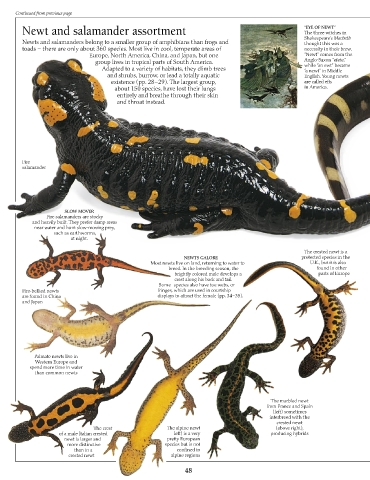
        Fire
        salamander


                      SLOW MOVER
                Fire salamanders are stocky
            and heavily built. They prefer damp areas
            near water and hunt slow-moving prey,
                   such as earthworms,
                        at night.
                                                                                                      The crested newt is a
                                                              NEWTS GALORE                           protected species in the
                                                   Most newts live on land, returning to water to       U.K., but it is also
                                                         breed. In the breeding season, the               found in other
                                                           brightly colored male develops a               parts of Europe
                                                           crest along his back and tail.
                                                      Some  species also have toe webs, or
        Fire-bellied newts                           fringes, which are used in courtship
        are found in China                           displays to attract the female (pp. 34–35).
        and Japan


            Palmate newts live in
             Western Europe and
           spend more time in water
             than common newts


                                                                                           The marbled newt
                                                                                         from France and Spain
                                                                                           (left) sometimes
                                                                                          interbreed with the
                                                                                             crested newt
                                The crest               The alpine newt                     (above right),
                     of a male Italian crested             left) is a very                 producing hybrids
                      newt is larger and                pretty European
                       more distinctive                 species but is not
                          than in a                         confined to
                        crested newt                      alpine regions
                                                              4

