


Page 52 - Amphibian
P. 52
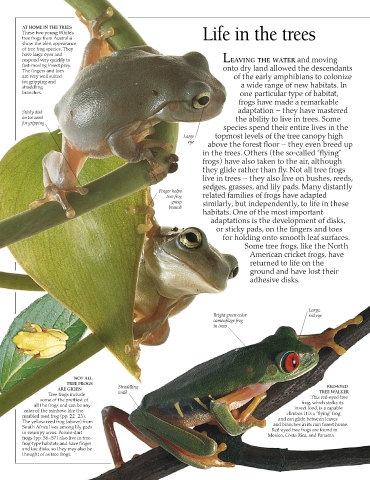
AT HOME IN THE TREES
        These two young White’s                                     Life in the trees
        tree frogs from Australia
        show the alert appearance
        of tree frog species. They
        have large eyes and
        respond very quickly to                                            Leaving the water and moving
        fast-moving insect prey.                                           onto dry land allowed the descendants
        The fingers and toes
        are very well suited                                                  of the early amphibians to colonize
        for gripping and
        straddling                                                               a wide range of new habitats. In
        branches.                                                               one particular type of habitat,
                                                                                frogs have made a remarkable
        Sticky disk                                                             adaptation – they have mastered
        on toe used                                                            the ability to live in trees. Some
        for gripping
                                                                           species spend their entire lives in the
                                                              Large     topmost levels of the tree canopy high
                                                               eye    above the forest floor – they even breed up
                                                                    in the trees. Others (the so-called “flying”
                                                                    frogs) have also taken to the air, although
                                                                    they glide rather than fly. Not all tree frogs
                                                                    live in trees – they also live on bushes, reeds,
                                                                    sedges, grasses, and lily pads. Many distantly
                                                      Finger helps
                                                        tree frog   related families of frogs have adapted
                                                          grasp     similarly, but independently, to life in these
                                                         branch
                                                                    habitats. One of the most important
                                                                       adaptations is the development of disks,
                                                                         or sticky pads, on the fingers and toes
                                                                           for holding onto smooth leaf surfaces.
                                                                                  Some tree frogs, like the North
                                                                                    American cricket frogs, have
                                                                                    returned to life on the
                                                                                    ground and have lost their
                                                                                    adhesive disks.


                                                                                                       Large,
                                                                        Bright green color             red eye
                                                                        camouflage frog
                                                                        in trees


                         NOT ALL
                       TREE FROGS                                                                            RED-EYED
                    ARE GREEN           Straddling
                 Tree frogs include     walk                                                               TREE WALKER
              some of the prettiest of                                                                  This red-eyed tree
            all the frogs and can be any                                                             frog, which stalks its
         color of the rainbow, like the                                                           insect food, is a capable
        marbled reed frog (pp. 22–23).                                                          climber. It is a “flying” frog
        The yellow reed frog (above) from                                                    and can glide between leaves
        South Africa lives among lily pads                                                 and branches in its rain forest home.
        in swampy areas. Poison-dart                                                       Red-eyed tree frogs are found in
        frogs (pp. 56–57) also live in tree-                                              Mexico, Costa Rica, and Panama.
        frog-type habitats and have finger
        and toe disks, so they may also be
        thought of as tree frogs.

