


Page 49 - Amphibian
P. 49
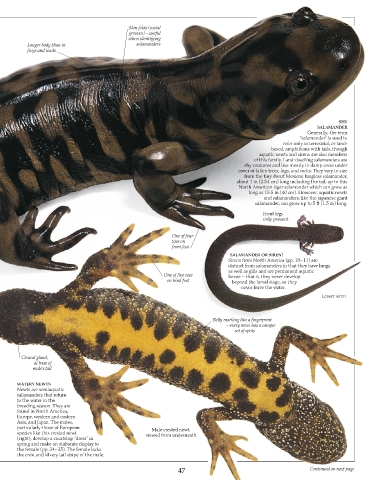
Skin folds (costal
                                            grooves) – useful
                                            when identifying
          Longer body than in                 salamanders
          frogs and toads


                                                                                                                 SHY
                                                                                                          SALAMANDER
                                                                                                       Generally, the term
                                                                                                    “salamander” is used to
                                                                                               refer only to terrestrial, or land-
                                                                                           based, amphibians with tails, though
                                                                                       aquatic newts and sirens are also members
                                                                                     of this family. Land-dwelling salamanders are
                                                                                  shy creatures and live mostly in damp areas under
                                                                                cover of fallen trees, logs, and rocks. They vary in size
                                                                                  from the tiny dwarf Mexican lungless salamander,
                                                                               about 1 in (2.54 cm) long including the tail, up to this
                                                                                North American tiger salamander which can grow as
                                                                                   long as 15.5 in (40 cm). However, aquatic newts
                                                                                        and salamanders, like the Japanese giant
                                                                                     salamander, can grow up to 5 ft (1.5 m) long.

                                                                                        Front legs
                                                                                        only present

                                                          One of four
                                                          toes on
                                                          front foot
                                                                             SALAMANDER OR SIREN?
                                                                             Sirens from North America (pp. 10–11) are
                                                                             distinct from salamanders in that they have lungs
                                                                             as well as gills and are permanent aquatic
                                                       One of five toes      larvae – that is, they never develop
                                                        on hind foot          beyond the larval stage, so they
                                                                                 never leave the water.
                                                                                                           Lesser siren


                                                                        Belly marking like a fingerprint
                                                                            – every newt has a unique
                                                                               set of spots


        Cloacal gland,
            at base of
            male’s tail

       WATERY NEWTS
       Newts are semiaquatic
       salamanders that return
       to the water in the
       breeding season. They are
       found in North America,
       Europe, western and eastern
       Asia, and Japan. The males,
       particularly those of European              Male crested newt,
       species like this crested newt            viewed from underneath
       (right), develop a courtship “dress” in
       spring and make an elaborate display to
       the female (pp. 34–35). The female lacks
       the crest and silvery tail stripe of the male.

                                                            4                                           Continued on next page

