


Page 48 - Amphibian
P. 48
Tailed amphibians
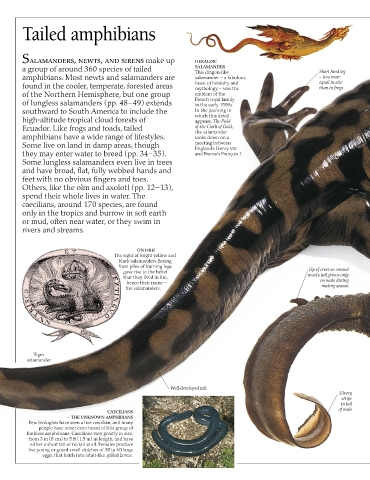
Salamanders, newts, and sirens make up HERALDIC
a group of around 360 species of tailed SALAMANDER Short hind leg
This dragon-like
amphibians. Most newts and salamanders are salamander – a fabulous – toes more
found in the cooler, temperate, forested areas beast of heraldry and equal in size
than in frogs
mythology – was the
of the Northern Hemisphere, but one group emblem of the
of lungless salamanders (pp. 48–49) extends French royal family
in the early 1500s.
southward to South America to include the In the painting in
high-altitude tropical cloud forests of which this detail
appears, The Field
Ecuador. Like frogs and toads, tailed of the Cloth of Gold,
the salamander
amphibians have a wide range of lifestyles. looks down on a
Some live on land in damp areas, though meeting between
England’s Henry viii
they may enter water to breed (pp. 34–35). and France’s François I.
Some lungless salamanders even live in trees
and have broad, flat, fully webbed hands and
feet with no obvious fingers and toes.
Others, like the olm and axolotl (pp. 12–13),
spend their whole lives in water. The
caecilians, around 170 species, are found
only in the tropics and burrow in soft earth
or mud, often near water, or they swim in
rivers and streams.
ON FIRE!
The sight of bright yellow and
black salamanders fleeing
from piles of burning logs
gave rise to the belief Tip of crest on crested
that they lived in fire, newt’s tail grows only
hence their name – on male during
fire salamanders. mating season
Tiger
salamander
Welldeveloped tail
Silvery
stripe
in tail
of male
CAECILIANS
– THE UNKNOWN AMPHIBIANS
Few biologists have seen a live caecilian, and many
people have never even heard of this group of
limbless amphibians. Caecilians vary greatly in size,
from 3 in (8 cm) to 5 ft (1.5 m) in length, and have
either a short tail or no tail at all. Females produce
live young or guard small clutches of 30 to 60 large
eggs, that hatch into adult-like, gilled larvae.

