


Page 56 - Amphibian
P. 56
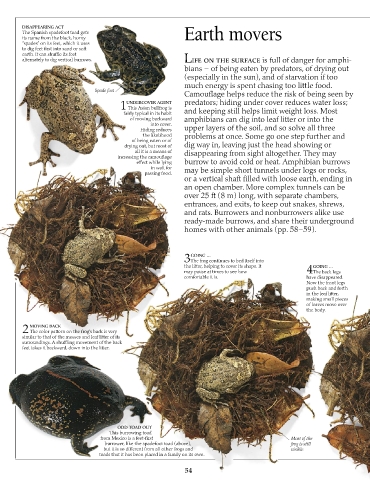
DISAPPEARING ACT
        The Spanish spadefoot toad gets                       Earth movers
        its name from the black, horny
        “spades” on its feet, which it uses
        to dig feet first into sand or soft
        earth. It can shuffle its feet
        alternately to dig vertical burrows.                  Life on the surface is full of danger for amphi-
                                                              bians – of being eaten by predators, of drying out
                                                              (especially in the sun), and of starvation if too
                                                              much energy is spent chasing too little food.
                                Spade foot
                                                              Camouflage helps reduce the risk of being seen by
                                           UNDERCOVER AGENT   predators; hiding under cover reduces water loss;
                                         1 This Asian bullfrog is   and keeping still helps limit weight loss. Most
                                          fairly typical in its habit
                                            of moving backward   amphibians can dig into leaf litter or into the
                                                   into cover.
                                               Hiding reduces   upper layers of the soil, and so solve all three
                                                the likelihood   problems at once. Some go one step further and
                                             of being eaten or of
                                          drying out, but most of   dig way in, leaving just the head showing or
                                              all it is a means of   disappearing from sight altogether. They may
                                        increasing the camouflage
                                              effect while lying   burrow to avoid cold or heat. Amphibian burrows
                                                   in wait for   may be simple short tunnels under logs or rocks,
                                                 passing food.
                                                              or a vertical shaft filled with loose earth, ending in
                                                              an open chamber. More complex tunnels can be
                                                              over 25 ft (8 m) long, with separate chambers,
                                                              entrances, and exits, to keep out snakes, shrews,
                                                              and rats. Burrowers and nonburrowers alike use
                                                              ready-made burrows, and share their underground
                                                              homes with other animals (pp. 58–59).


                                                                GOING …
                                                              3The frog continues to bed itself into
                                                              the litter, helping to cover its shape. It   GOING …
                                                              may pause at times to see how           4The back legs
                                                              comfortable it is.                      have disappeared.
                                                                                                      Now the front legs
                                                                                                      push back and forth
                                                                                                      in the leaf litter,
                                                                                                      making small pieces
                                                                                                      of leaves move over
                                                                                                      the body.

            MOVING BACK
        2 The color pattern on the frog’s back is very
        similar to that of the mosses and leaf litter of its
        surroundings. A shuffling movement of the back
        feet takes it backward, down into the litter.


                                        ODD TOAD OUT
                                     This burrowing toad
                                  from Mexico is a feet-first                                    Most of the
                                    burrower, like the spadefoot toad (above),                   frog is still
                                   but it is so different from all other frogs and               visible
                                  toads that it has been placed in a family on its own.

                                                              54

