


Page 61 - Amphibian
P. 61
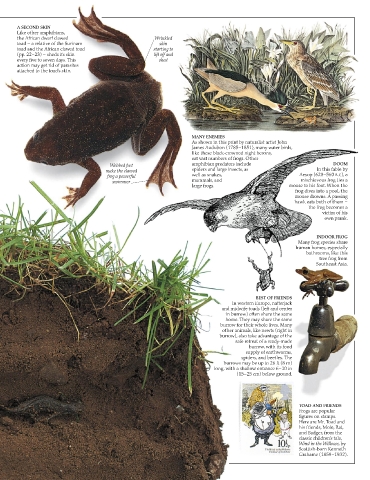
A SECOND SKIN
       Like other amphibians,
       the African dwarf clawed                     Wrinkled
       toad – a relative of the Surinam               skin
       toad and the African clawed toad             starting to
       (pp. 22–23) – sheds its skin                 lift off and
       every five to seven days. This                 shed
       action may get rid of parasites
       attached to the toad’s skin.


                                                                 MANY ENEMIES
                                                                 As shown in this print by naturalist artist John
                                                                 James Audubon (1785–1851), many water birds,
                                                                 like these black-crowned night herons,
                                                                 eat vast numbers of frogs. Other
                                     Webbed feet                 amphibian predators include                   DOOM
                                    make the clawed              spiders and large insects, as            In this fable by
                                     frog a powerful             well as snakes,                    Aesop (620–560 b.c), a
                                      swimmer                    mammals, and                        mischievous frog ties a
                                                                 large frogs.                    mouse to his foot. When the
                                                                                                   frog dives into a pool, the
                                                                                                   mouse drowns. A passing
                                                                                                  hawk eats both of them –
                                                                                                       the frog becomes a
                                                                                                            victim of his
                                                                                                            own prank.


                                                                                                          INDOOR FROG
                                                                                                    Many frog species share
                                                                                                   human homes, especially
                                                                                                      bathrooms, like this
                                                                                                           tree frog from
                                                                                                          Southeast Asia.


                                                                                      BEST OF FRIENDS
                                                                              In western Europe, natterjack
                                                                          and midwife toads (left and center
                                                                            in burrow) often share the same
                                                                            home. They may share the same
                                                                          burrow for their whole lives. Many
                                                                           other animals, like newts (right in
                                                                          burrow), also take advantage of the
                                                                               safe retreat of a ready-made
                                                                                   burrow, with its food
                                                                                  supply of earthworms,
                                                                                 spiders, and beetles. The
                                                                           burrows may be up to 26 ft (8 m)
                                                                        long, with a shallow entrance 6–10 in
                                                                               (15–25 cm) below ground.


                                                                                                    TOAD AND FRIENDS
                                                                                                    Frogs are popular
                                                                                                    figures on stamps.
                                                                                                    Here are Mr. Toad and
                                                                                                    his friends, Mole, Rat,
                                                                                                    and Badger, from the
                                                                                                    classic children’s tale,
                                                                                                    Wind in the Willows, by
                                                                                                    Scottish-born Kenneth
                                                                                                    Grahame (1859–1932).

