


Page 8 - Amphibian
P. 8
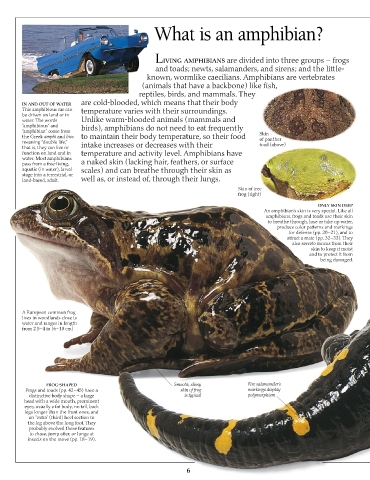
What is an amphibian?


                                                    Living amphibians are divided into three groups – frogs
                                                    and toads; newts, salamanders, and sirens; and the little-
                                                  known, wormlike caecilians. Amphibians are vertebrates
                                                (animals that have a backbone) like fish,
                                               reptiles, birds, and mammals. They

        IN AND OUT OF WATER  are cold-blooded, which means that their body
        This amphibious car can   temperature varies with their surroundings.
        be driven on land or in
        water. The words    Unlike warm-blooded animals (mammals and
        “amphibious” and    birds), amphibians do not need to eat frequently
        “amphibian” come from                                                          Skin
        the Greek amphi and bios   to maintain their body temperature, so their food   of panther
        meaning “double life,”   intake increases or decreases with their              toad (above)
        that is, they can live or
        function on land and in   temperature and activity level. Amphibians have
        water. Most amphibians
        pass from a free-living,   a naked skin (lacking hair, feathers, or surface
        aquatic (in water), larval   scales) and can breathe through their skin as
        stage into a terrestrial, or
        land-based, adult.  well as, or instead of, through their lungs.
                                                                                Skin of tree
                                                                                frog (right)
                                                                                                          ONLY SKIN DEEP
                                                                                        An amphibian’s skin is very special. Like all
                                                                                         amphibians, frogs and toads use their skin
                                                                                          to breathe through, lose or take up water,
                                                                                             produce color patterns and markings
                                                                                                 for defense (pp. 20–21), and to
                                                                                                attract a mate (pp. 32–33). They
                                                                                                  also secrete mucus from their
                                                                                                        skin to keep it moist
                                                                                                       and to protect it from
                                                                                                           being damaged.


        A European common frog
        lives in woodlands close to
        water and ranges in length
        from 2.5–4 in (6–10 cm)


                FROG-SHAPED                                Smooth, slimy           Fire salamander’s
         Frogs and toads (pp. 42–45) have a                  skin of frog          markings display
           distinctive body shape – a large                   is typical           polymorphism
         head with a wide mouth, prominent
         eyes, usually a fat body, no tail, back
         legs longer than the front ones, and
           an “extra” (third) heel section to
          the leg above the long foot. They
           probably evolved these features
           to chase, jump after, or lunge at
          insects on the move (pp. 18–19).

