


Page 9 - Amphibian
P. 9
What is not an amphibian?

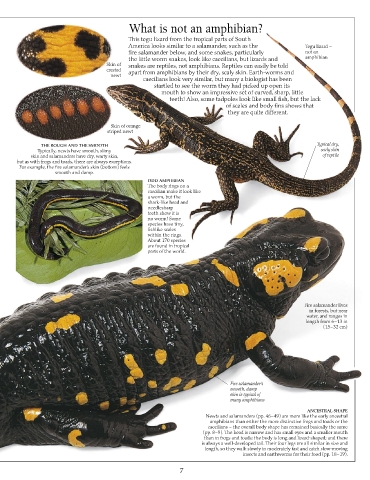
                                            This tegu lizard from the tropical parts of South
                                            America looks similar to a salamander, such as the        Tegu lizard –
                                            fire salamander below, and some snakes, particularly      not an
                                            the little worm snakes, look like caecilians, but lizards and   amphibian
                                    Skin of   snakes are reptiles, not amphibians. Reptiles can easily be told
                                    crested   apart from amphibians by their dry, scaly skin. Earth-worms and
                                      newt
                                                caecilians look very similar, but many a biologist has been
                                                    startled to see the worm they had picked up open its
                                                      mouth to show an impressive set of curved, sharp, little
                                                         teeth! Also, some tadpoles look like small fish, but the lack
                                                                            of scales and body fins shows that
                                                                            they are quite different.

                                      Skin of orange
                                     striped newt


               THE ROUGH AND THE SMOOTH                                                                   Typical dry,
             Typically, newts have smooth, slimy                                                           scaly skin
           skin and salamanders have dry, warty skin,                                                       of reptile
       but as with frogs and toads, there are always exceptions.
       For example, the fire salamander’s skin (bottom) feels
                   smooth and damp.
                                                  ODD AMPHIBIAN
                                                  The body rings on a
                                                  caecilian make it look like
                                                  a worm, but the
                                                  shark-like head and
                                                  needlesharp
                                                  teeth show it is
                                                  no worm! Some
                                                  species have tiny,
                                                  fishlike scales
                                                  within the rings.
                                                  About 170 species
                                                  are found in tropical
                                                  parts of the world.


                                                                                                      Fire salamander lives
                                                                                                       in forests, but near
                                                                                                      water, and ranges in
                                                                                                      length from 6–13 in
                                                                                                            (15–32 cm)


                                                                             Fire salamander’s
                                                                             smooth, damp
                                                                             skin is typical of
                                                                             many amphibians
                                                                                                       ANCESTRAL SHAPE
                                                                     Newts and salamanders (pp. 46–49) are more like the early ancestral
                                                                       amphibians than either the more distinctive frogs and toads or the
                                                                      caecilians – the overall body shape has remained basically the same
                                                                    (pp. 8–9). The head is narrow and has small eyes and a smaller mouth
                                                                     than in frogs and toads; the body is long and lizard-shaped; and there
                                                                    is always a well-developed tail. Their four legs are all similar in size and
                                                                     length, so they walk slowly to moderately fast and catch slow-moving
                                                                                 insects and earthworms for their food (pp. 18–19).

