Page 12 - Amphibian
P. 12

The bare bones


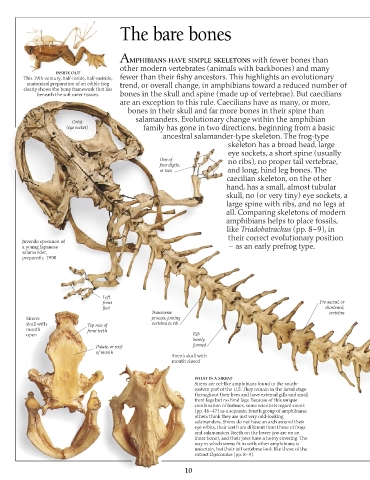
                                         Amphibians have simple skeletons with fewer bones than
                                         other modern vertebrates (animals with backbones) and many
                   INSIDE OUT
         This 19th-century, half-inside, half-outside,   fewer than their fishy ancestors. This highlights an evolutionary
          anatomical preparation of an edible frog   trend, or overall change, in amphibians toward a reduced number of
         clearly shows the bony framework that lies
             beneath the soft outer tissues.  bones in the skull and spine (made up of vertebrae). But caecilians
                                         are an exception to this rule. Caecilians have as many, or more,
                                           bones in their skull and far more bones in their spine than
                                              salamanders. Evolutionary change within the amphibian
                         Orbit
                       (eye socket)             family has gone in two directions, beginning from a basic
                                                       ancestral salamander-type skeleton. The frog-type
                                                                            skeleton has a broad head, large
                                                                            eye sockets, a short spine (usually
                                                      One of                no ribs), no proper tail vertebrae,
                                                      four digits,
                                                      or toes               and long, hind leg bones. The
                                                                            caecilian skeleton, on the other
                                                                            hand, has a small, almost tubular
                                                                            skull, no (or very tiny) eye sockets, a
                                                                            large spine with ribs, and no legs at
                                                                            all. Comparing skeletons of modern
                                                                            amphibians helps to place fossils,
                                                                            like Triadobatrachus (pp. 8–9), in
                                                                            their correct evolutionary position
        Juvenile specimen of
        a young Japanese                                                     – as an early prefrog type.
        salamander,
        prepared c. 1900


                                   Left
                                   front                                                                   Pre­sacral, or
                                   foot                                                                      shortened,
                                                   Transverse                                                 vertebra
          Siren’s                                  process, joining
          skull with          Top row of           vertebra to rib
          mouth               front teeth
          open                                                   Rib
                                                                 barely
                                 Palate, or roof                 formed
                                 of mouth
                                                          Siren’s skull with
                                                          mouth closed


                                                                 WHAT IS A SIREN?
                                                                 Sirens are eel-like amphibians found in the south-
                                                                 eastern part of the U.S. They remain in the larval stage
                                                                 throughout their lives and have external gills and small
                                                                 front legs but no hind legs. Because of this unique
                                                                 combination of features, some scientists regard sirens
                                                                 (pp. 46–47) as a separate, fourth group of amphibians;
                                                                 others think they are just very odd-looking
                                                                 salamanders. Sirens do not have an arch around their
                                                                 eye orbits, their teeth are different from those of frogs
                                                                 and salamanders (teeth on the lower jaw are on an
                                                                 inner bone), and their jaws have a horny covering. The
                                                                 way in which sirens fit in with other amphibians is
                                                                 uncertain, but their tail vertebrae look like those of the
                                                                 extinct Diplocaulus (pp. 8–9).

                                                              10
   7   8   9   10   11   12   13   14   15   16   17