


Page 26 - World of Animals - Issue #28 Magazine
P. 26
Amazing arthropods


            Giraffe weevils have

            extended necks to

            build better nests

            and fight rivals


            These highly unusual-looking flying insects, native only
            to Madagascar, have long legs and short, red bodies but
            their most notable attribute – thanks to their very long
            necks – is their resemblance to giraffes. The necks serve a
            multitude of purposes, from allowing the insects to reach
            the leaves of the giraffe beetle trees in which they live, to
            letting them build impressive nests – the females roll leaves
            into tubes before laying a single egg into them. For males,
            though, the necks are perfect for aggressive displays.
            They use them to lash out at male rivals in fierce battles

            for the right to mate with a female. A male’s neck is up to
            three times as long as a female’s, making it effective for
            wrestling and pushing opponents until one admits defeat.
             GIRAFFE WEEVIL
             Trachelophorus giraffa
             Class Insecta


             Territory Madagascar
             Diet Leaves
             Lifespan One year
             Adult weight 2g (0.1oz)
             Conservation status

              NOT EVALUATED


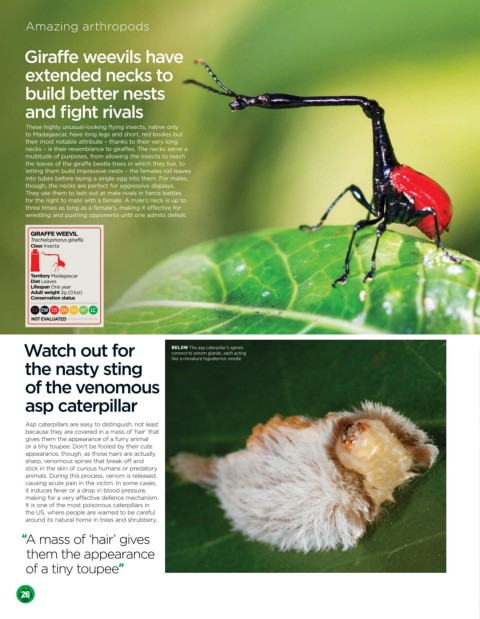
            Watch out for                           BELOW The asp caterpillar’s spines
                                                    connect to venom glands, each acting
            the nasty sting                         like a miniature hypodermic needle

            of the venomous

            asp caterpillar


            Asp caterpillars are easy to distinguish, not least
            because they are covered in a mass of ‘hair’ that
            gives them the appearance of a furry animal
            or a tiny toupee. Don’t be fooled by their cute
            appearance, though, as those hairs are actually
            sharp, venomous spines that break off and
            stick in the skin of curious humans or predatory
            animals. During this process, venom is released,
            causing acute pain in the victim. In some cases,
            it induces fever or a drop in blood pressure,
            making for a very effective defence mechanism.
            It is one of the most poisonous caterpillars in
            the US, where people are warned to be careful
            around its natural home in trees and shrubbery.

           “A mass of ‘hair’ gives
            them the appearance

            of a tiny toupee”


           26

