


Page 60 - World of Animals - Issue #28 Magazine
P. 60
Robins: heroes or villains?
            Ro   b i n s:  h e r o e s  o r  vi l l a i n s ?

            Singing for their life


            If there were an X Factor-style contest for songbirds, robins
            would have a good chance of winning based on endurance
            alone. Unlike a lot of ‘fair-weather crooners’, robins are among
            the few species which sing throughout the year. What’s more,
            they are some of the earliest risers and the latest to retire –
            especially in urban areas with lots of streetlights.
              These birds aren’t just chirruping because they like the
            sound of their own voices. What we might hear as the white
            noise of nature is, in fact, vital to a robin’s survival. Firstly, it’s
            a way of enticing a mate to come into their territory, and
            secondly, it’s a warning to potential trespassers.
              Interestingly, the tone of the robin’s song differs
            according to the season. As ornithologist Bill Oddie
            explains, “It’s not a strong change but it would be if you
            heard both songs against the other, like adjacent tracks
            on an album. The winter song is thinner and more
            wistful. Then when you get to spring, it gets richer
            and louder, and there are more notes to it.
              “In autumn, they also have ‘sub-songs’ which
            are almost inaudible – just tiny little chattering
            notes. Then there’s also a hard, metallic ticking
            noise they make. Like most birds, they’ve got
            several calls.”


               What’s in a name?

               The earliest records refer to this bird as
               the ‘redbreast’. However, during the 15th
               century, a trend arose for christening
               animals with human names, resulting
               in the emergence of ‘robin redbreast’.
               Subsequently this was shortened to
               ‘robin’, though ‘robinet’ and ‘ruddock’ are
               also documented.
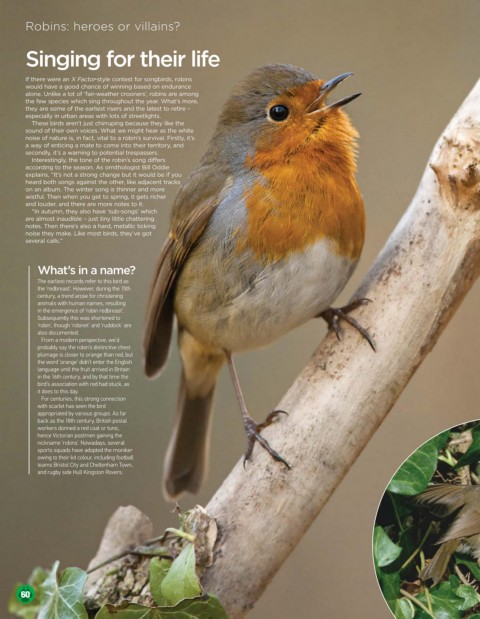
                From a modern perspective, we’d
               probably say the robin’s distinctive chest
               plumage is closer to orange than red, but
               the word ‘orange’ didn’t enter the English
               language until the fruit arrived in Britain
               in the 16th century, and by that time the
               bird’s association with red had stuck, as
               it does to this day.
                For centuries, this strong connection
               with scarlet has seen the bird
               appropriated by various groups. As far
               back as the 18th century, British postal
               workers donned a red coat or tunic,
               hence Victorian postmen gaining the
               nickname ‘robins’. Nowadays, several
               sports squads have adopted the moniker
               owing to their kit colour, including football
               teams Bristol City and Cheltenham Town,
               and rugby side Hull Kingston Rovers.


           60 60

