


Page 61 - World of Animals - Issue #28 Magazine
P. 61
Robins in our culture Animals in culture
Meet the other animals that feature in our
stories, sayings, names and festivities
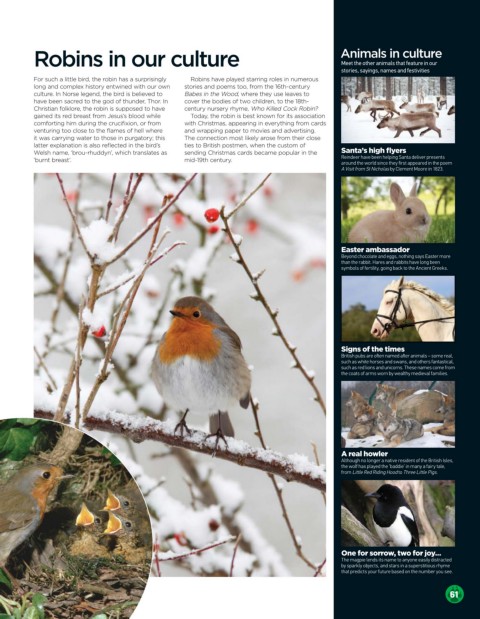
For such a little bird, the robin has a surprisingly Robins have played starring roles in numerous
long and complex history entwined with our own stories and poems too, from the 16th-century
culture. In Norse legend, the bird is believed to Babes in the Wood, where they use leaves to
have been sacred to the god of thunder, Thor. In cover the bodies of two children, to the 18th-
Christian folklore, the robin is supposed to have century nursery rhyme, Who Killed Cock Robin?
gained its red breast from Jesus’s blood while Today, the robin is best known for its association
comforting him during the crucifixion, or from with Christmas, appearing in everything from cards
venturing too close to the flames of hell where and wrapping paper to movies and advertising.
it was carrying water to those in purgatory; this The connection most likely arose from their close
latter explanation is also reflected in the bird’s ties to British postmen, when the custom of
Welsh name, ‘brou-rhuddyn’, which translates as sending Christmas cards became popular in the Santa’s high flyers
‘burnt breast’. mid-19th century. Reindeer have been helping Santa deliver presents
around the world since they first appeared in the poem
A Visit from St Nicholas by Clement Moore in 1823.
Easter ambassador
Beyond chocolate and eggs, nothing says Easter more
than the rabbit. Hares and rabbits have long been
symbols of fertility, going back to the Ancient Greeks.
Signs of the times
British pubs are oen named aer animals – some real,
such as white horses and swans, and others fantastical,
such as red lions and unicorns. These names come from
the coats of arms worn by wealthy medieval families.
A real howler
Although no longer a native resident of the British Isles,
the wolf has played the ‘baddie’ in many a fairy tale,
from Little Red Riding Hood to Three Little Pigs.
One for sorrow, two for joy…
The magpie lends its name to anyone easily distracted
by sparkly objects, and stars in a superstitious rhyme
that predicts your future based on the number you see.
61 61

