


Page 100 - (DK) Home Doctor: Providing practical advice on home treatments
P. 100
98   COMMON CONDITIONS: HEAD, BACK, AND LIMB PROBLEMS

         Bunions


              A bunion is a bump at the base of the big toe, caused by a deformity
              of the joint. If you have bunions, your big toes are pushed inward,
              and the protruding toe joints may become red, tender, and swollen.
              You may also get corns and calluses over the joints if your shoes rub.
              Bunions tend to run in families. Pressure from narrow shoes contributes
              to the problem, making bunions more common in women.
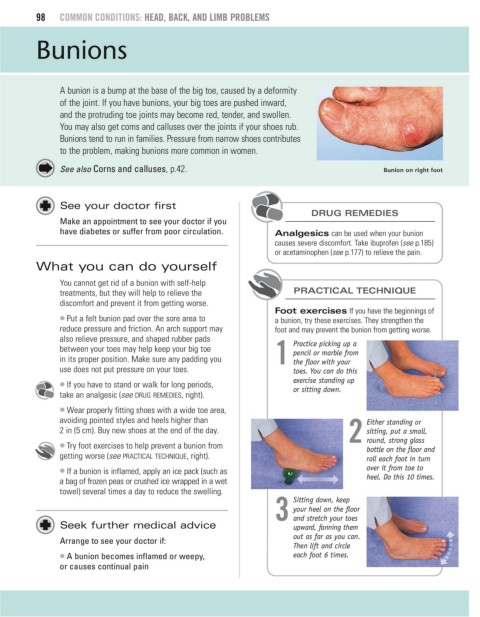
              See also Corns and calluses, p.42.                                    Bunion on right foot


              See your doctor first
                                                                    DRUG REMEDIES
              Make an appointment to see your doctor if you
              have diabetes or suffer from poor circulation.  Analgesics can be used when your bunion
                                                            causes severe discomfort. Take ibuprofen (see p.185)
                                                            or acetaminophen (see p.177) to relieve the pain.
         What you can do yourself

              You cannot get rid of a bunion with self-help
              treatments, but they will help to relieve the     PRACTICAL TECHNIQUE
              discomfort and prevent it from getting worse.
                                                            Foot exercises If you have the beginnings of
              ● Put a felt bunion pad over the sore area to  a bunion, try these exercises. They strengthen the
              reduce pressure and friction. An arch support may  foot and may prevent the bunion from getting worse.
              also relieve pressure, and shaped rubber pads     Practice picking up a
              between your toes may help keep your big toe      pencil or marble from
              in its proper position. Make sure any padding you  1 the floor with your
              use does not put pressure on your toes.           toes. You can do this
                                                                exercise standing up
              ● If you have to stand or walk for long periods,
                                                                or sitting down.
              take an analgesic (see DRUG REMEDIES, right).
              ● Wear properly fitting shoes with a wide toe area,
              avoiding pointed styles and heels higher than                     Either standing or
              2 in (5 cm). Buy new shoes at the end of the day.                 sitting, put a small,
                                                                            2 round, strong glass
              ● Try foot exercises to help prevent a bunion from
                                                                                bottle on the floor and
              getting worse (see PRACTICAL TECHNIQUE, right).                   roll each foot in turn
              ● If a bunion is inflamed, apply an ice pack (such as             over it from toe to
                                                                                heel. Do this 10 times.
              a bag of frozen peas or crushed ice wrapped in a wet
              towel) several times a day to reduce the swelling.
                                                                Sitting down, keep
                                                                your heel on the floor
                                                            3 and stretch your toes
              Seek further medical advice                       upward, fanning them
                                                                out as far as you can.
              Arrange to see your doctor if:
                                                                Then lift and circle
              ● A bunion becomes inflamed or weepy,             each foot 6 times.
              or causes continual pain

