


Page 141 - (DK) Home Doctor: Providing practical advice on home treatments
P. 141
COMMON CONDITIONS: CHILDREN’S PROBLEMS  139

         Bedwetting


              Although most children become reliably dry at night between the ages of 3 and 7, bedwetting (enuresis) is a
              common problem for young children. Around 1 in 6 still wet the bed at 5 years; around 1 in 20 are still wetting
              at age 10. Your child may need treatment if he or she continues after age 7, or starts again after 6 months or
              more of dry nights. If your child wets the bed regularly, it is most likely to be because he or she has not yet
              learned bladder control; this will improve in time. Bedwetting is rarely caused by a physical or psychological
              problem, although a child who has been dry at night may have lapses due to a bladder infection or an emotional
              upset such as bullying; constipation may also be a contributory factor. Bedwetting tends to run in families.


              See your doctor first
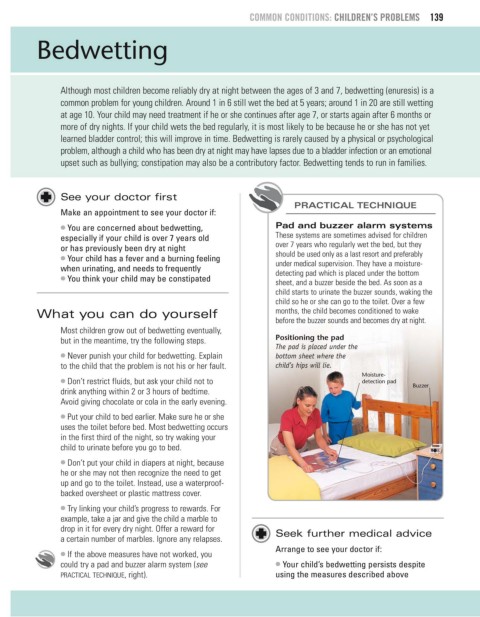
                                                                 PRACTICAL TECHNIQUE
              Make an appointment to see your doctor if:
              ● You are concerned about bedwetting,         Pad and buzzer alarm systems
              especially if your child is over 7 years old  These systems are sometimes advised for children
              or has previously been dry at night           over 7 years who regularly wet the bed, but they
              ● Your child has a fever and a burning feeling  should be used only as a last resort and preferably
                                                            under medical supervision. They have a moisture-
              when urinating, and needs to frequently       detecting pad which is placed under the bottom
              ● You think your child may be constipated
                                                            sheet, and a buzzer beside the bed. As soon as a
                                                            child starts to urinate the buzzer sounds, waking the
                                                            child so he or she can go to the toilet. Over a few
         What you can do yourself                           months, the child becomes conditioned to wake
                                                            before the buzzer sounds and becomes dry at night.
              Most children grow out of bedwetting eventually,
              but in the meantime, try the following steps.  Positioning the pad
                                                            The pad is placed under the
              ● Never punish your child for bedwetting. Explain  bottom sheet where the
              to the child that the problem is not his or her fault.   child’s hips will lie.
                                                                               Moisture-
              ● Don’t restrict fluids, but ask your child not to               detection pad
                                                                                          Buzzer
              drink anything within 2 or 3 hours of bedtime.
              Avoid giving chocolate or cola in the early evening.
              ● Put your child to bed earlier. Make sure he or she
              uses the toilet before bed. Most bedwetting occurs
              in the first third of the night, so try waking your
              child to urinate before you go to bed.
              ● Don’t put your child in diapers at night, because
              he or she may not then recognize the need to get
              up and go to the toilet. Instead, use a waterproof-
              backed oversheet or plastic mattress cover.
              ● Try linking your child’s progress to rewards. For
              example, take a jar and give the child a marble to
              drop in it for every dry night. Offer a reward for   Seek further medical advice
              a certain number of marbles. Ignore any relapses.
                                                            Arrange to see your doctor if:
              ● If the above measures have not worked, you
              could try a pad and buzzer alarm system (see  ● Your child’s bedwetting persists despite
              PRACTICAL TECHNIQUE, right).                  using the measures described above

