


Page 146 - (DK) Home Doctor: Providing practical advice on home treatments
P. 146
144 COMMON CONDITIONS: PROBLEMS IN BABIES

         Feeding problems


              Most feeding problems in babies occur in the early months. Some newborns need practice at latching on
              to the breast, while bottle-fed babies may have trouble with different sizes of nipples and types of formula.
              Babies who are not getting enough milk are often excessively sleepy and slow to gain weight, while those
              who are overfed gain weight too quickly. Many breast-fed and bottle-fed babies effortlessly spit up small
              amounts of milk after a feeding; this is not a cause for concern. Some, however, regurgitate larger amounts
              of feeding and may wheeze. This condition, called reflux, may last for up to a year and is due to a weak
              muscle at the entrance to the stomach. It is most common in premature babies or those whose muscle tone
              is poor. A baby who feeds well but wakes screaming between feedings may have an allergy to milk.

              See also Cracked nipples, p.126; Colic, p.148.


              See your doctor first
                                                                PRACTICAL TECHNIQUE
              Make an appointment to see your doctor if:
              ● Your baby can't feed or won't feed          Successful breast-feeding It may
                                                            take a little practice for both you and your baby to
              ● Your baby has been feeding well, but has
                                                            get breast-feeding right. These simple steps will help.
              developed problems
              ● Your baby regurgitates large volumes of milk  ● Hold your baby with the head cradled in the crook
              and/or there is blood in the vomit            of your arm, the bottom well supported and the arm
              ● Your baby fails to gain or loses weight     tucked around your body. Whenever possible, have
                                                            skin to skin contact with your baby during feedings.
                                                            ● Stroke your baby’s cheek with a finger or your nipple
                                                            so that the mouth opens wide and your baby turns
         What you can do yourself                           toward the nipple. Expressing a little milk onto the
                                                            nipple will help encourage your baby.
              Most feeding problems resolve themselves over  ● Aiming your nipple at the roof of the baby’s mouth,
              time, but using the following tips will help. You  make sure the nipple and as much of the areola around
              can be sure that your newborn baby is feeding well  it as possible is taken into the mouth. When the
              if he or she produces 6 or more wet diapers a day,  baby closes his or her mouth it will form a tight seal.
              sleeps well, and gains weight at the predicted rate.   ● If your baby sucks only on the end of the nipple, he
                                                            or she will not be getting milk and your nipple may
              ● Make sure your newborn baby feeds properly at
                                                            become sore. Ease the baby off the breast by gently
              least 6 times in 24 hours. Don’t assume a sleepy  inserting a finger into the corner of the mouth and
              baby is "content"; wake your baby for feedings if  reposition him or her to try again.
              he or she is sleeping for more than 4 hours.
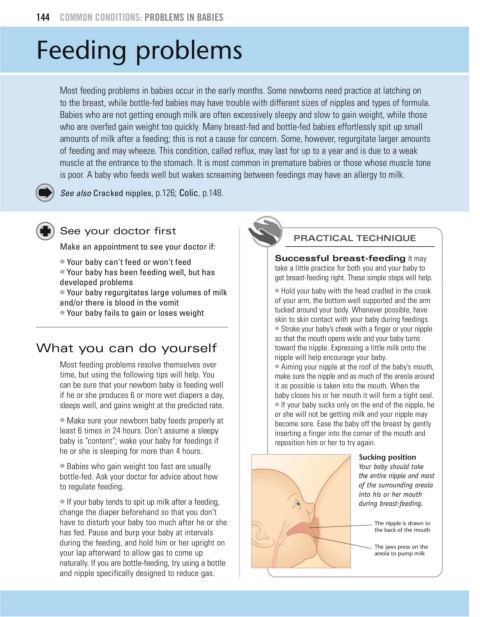
                                                                              Sucking position
              ● Babies who gain weight too fast are usually                   Your baby should take
              bottle-fed. Ask your doctor for advice about how                the entire nipple and most
              to regulate feeding.                                            of the surrounding areola
                                                                              into his or her mouth
              ● If your baby tends to spit up milk after a feeding,           during breast-feeding.
              change the diaper beforehand so that you don’t
              have to disturb your baby too much after he or she                  The nipple is drawn to
              has fed. Pause and burp your baby at intervals                      the back of the mouth
              during the feeding, and hold him or her upright on
                                                                                  The jaws press on the
              your lap afterward to allow gas to come up                          areola to pump milk
              naturally. If you are bottle-feeding, try using a bottle
              and nipple specifically designed to reduce gas.

