


Page 170 - (DK) Home Doctor: Providing practical advice on home treatments
P. 170
168 FIRST AID

         Unconsciousness


              Loss of consciousness is potentially life-threatening. It has many
                                                                            WARNING
              possible causes, including a serious injury such as head injury;
              severe bleeding; shock; poisoning; breathing difficulty; or serious  Call 911.
              illness. An unconscious victim will not respond to loud noises or  A victim who is unconscious needs
                                                                     emergency medical help.
              to being tapped or shaken, and will not move or make a sound.
              The eyes may stay closed. If the victim is lying face upward,
              there is a risk of the tongue blocking the airway, and of choking if
              he or she vomits. If breathing stops, resuscitation will be needed.


                                         PRACTICAL TECHNIQUE
              Helping an unconscious victim              to prevent him or her from choking on the tongue or on
              Your priorities are to get emergency medical help and to  any debris in the airway. You should also look for and
              assess the victim’s response, check breathing, and  treat any obvious injuries and be prepared to resuscitate
              maintain an open airway until help arrives. It is important  if breathing stops and/or blood circulation fails.

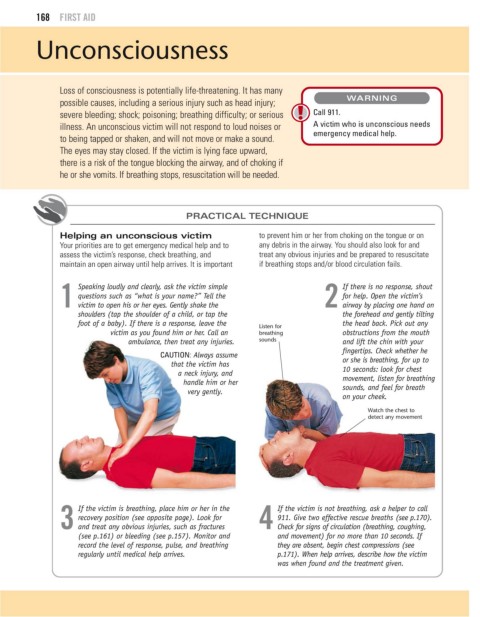
                  Speaking loudly and clearly, ask the victim simple       If there is no response, shout
                  questions such as “what is your name?” Tell the          for help. Open the victim’s
              1 victim to open his or her eyes. Gently shake the       2 airway by placing one hand on
                  shoulders (tap the shoulder of a child, or tap the       the forehead and gently tilting
                  foot of a baby). If there is a response, leave the  Listen for  the head back. Pick out any
                         victim as you found him or her. Call an  breathing  obstructions from the mouth
                             ambulance, then treat any injuries.   sounds  and lift the chin with your
                                                                           fingertips. Check whether he
                                    CAUTION: Always assume                 or she is breathing, for up to
                                      that the victim has                  10 seconds: look for chest
                                       a neck injury, and
                                         handle him or her                 movement, listen for breathing
                                          very gently.                     sounds, and feel for breath
                                                                           on your cheek.
                                                                                Watch the chest to
                                                                                detect any movement


                  If the victim is breathing, place him or her in the  If the victim is not breathing, ask a helper to call
                  recovery position (see opposite page). Look for  911. Give two effective rescue breaths (see p.170).
              3 and treat any obvious injuries, such as fractures  4 Check for signs of circulation (breathing, coughing,
                  (see p.161) or bleeding (see p.157). Monitor and  and movement) for no more than 10 seconds. If
                  record the level of response, pulse, and breathing  they are absent, begin chest compressions (see
                  regularly until medical help arrives.      p.171). When help arrives, describe how the victim
                                                             was when found and the treatment given.

