


Page 167 - (DK) Home Doctor: Providing practical advice on home treatments
P. 167
FIRST AID  165

         Shock


              This life-threatening condition occurs when the blood circulation
                                                                            WARNING
              fails, and vital organs such as the brain and heart are deprived of
              oxygen. The most common cause is severe blood loss, but loss of  Call 911 immediately.
              other body fluids, as occurs in severe burns, can also cause shock.  A victim suffering from shock needs
                                                                     urgent medical attention.
              The first signs are a rapid pulse; sweating; and pale, clammy skin.
              These are followed by a weak pulse; rapid, shallow breathing;
              thirst; restlessness; and weakness. The victim may become
              unconscious. If treatment is not given, the heart will stop.


                                         PRACTICAL TECHNIQUE
              Treating signs of shock                    CAUTION: Stay with the victim continually, unless you
              Shock deprives the brain, heart, and other vital organs of  have to leave him or her in order to call 911. Keep the
              oxygen, so the main goals of treatment are to improve the  victim still. Do not give anything to eat or drink; if the
              blood supply to the victim’s vital organs and to get him or  victim complains of feeling thirsty, moisten his or her
              her to the hospital as soon as possible.   lips with a little water.

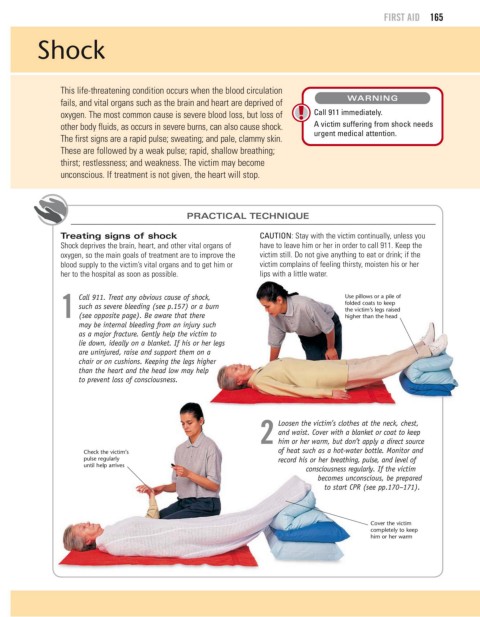
                  Call 911. Treat any obvious cause of shock,              Use pillows or a pile of
                  such as severe bleeding (see p.157) or a burn            folded coats to keep
                                                                           the victim’s legs raised
              1 (see opposite page). Be aware that there                   higher than the head
                  may be internal bleeding from an injury such
                  as a major fracture. Gently help the victim to
                  lie down, ideally on a blanket. If his or her legs
                  are uninjured, raise and support them on a
                  chair or on cushions. Keeping the legs higher
                  than the heart and the head low may help
                  to prevent loss of consciousness.


                                                             Loosen the victim’s clothes at the neck, chest,
                                                             and waist. Cover with a blanket or coat to keep
                                                         2 him or her warm, but don’t apply a direct source
                   Check the victim’s                        of heat such as a hot-water bottle. Monitor and
                   pulse regularly                           record his or her breathing, pulse, and level of
                   until help arrives
                                                                   consciousness regularly. If the victim
                                                                      becomes unconscious, be prepared
                                                                       to start CPR (see pp.170–171).


                                                                                 Cover the victim
                                                                                 completely to keep
                                                                                 him or her warm

