


Page 166 - (DK) Home Doctor: Providing practical advice on home treatments
P. 166
164 FIRST AID

         Burns and scalds


              Most minor burns occur in the home – for example, after
                                                                            WARNING
              touching a hot oven or spilling hot water. The skin turns red
              and the burn feels sore. Deeper burns tend to blister and are  Call 911 if:
              usually swollen and painful. Severe burns, which damage deeper  ● A burn is near the mouth or
                                                                     throat, or is extensive or deep
              layers of skin and sometimes the fat and nerves underneath,  ● There are signs of shock,
              may look gray and charred. There may be little or no pain. They  breathing problems, or a victim
              cause fluid loss and may lead to shock (see opposite page).   becomes unconscious


              Seek medical advice
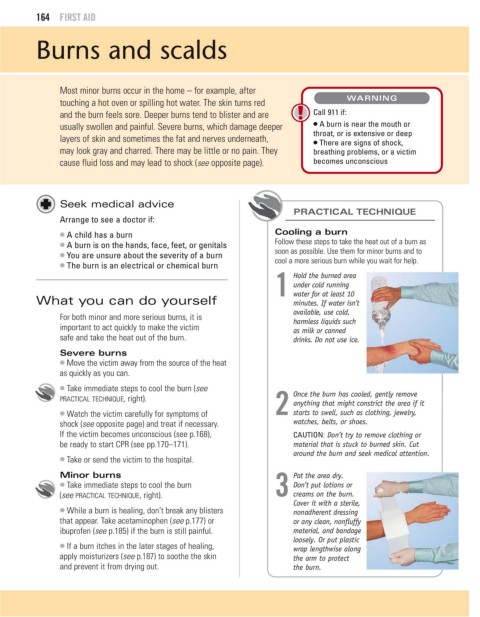
                                                                PRACTICAL TECHNIQUE
              Arrange to see a doctor if:
              ● A child has a burn                          Cooling a burn
                                                            Follow these steps to take the heat out of a burn as
              ● A burn is on the hands, face, feet, or genitals
                                                            soon as possible. Use them for minor burns and to
              ● You are unsure about the severity of a burn
                                                            cool a more serious burn while you wait for help.
              ● The burn is an electrical or chemical burn
                                                                Hold the burned area
                                                                under cold running
                                                            1 water for at least 10
         What you can do yourself                               minutes. If water isn’t
                                                                available, use cold,
              For both minor and more serious burns, it is
                                                                harmless liquids such
              important to act quickly to make the victim
                                                                as milk or canned
              safe and take the heat out of the burn.           drinks. Do not use ice.
              Severe burns
              ● Move the victim away from the source of the heat
              as quickly as you can.
              ● Take immediate steps to cool the burn (see
                                                                Once the burn has cooled, gently remove
              PRACTICAL TECHNIQUE, right).
                                                                anything that might constrict the area if it
              ● Watch the victim carefully for symptoms of  2 starts to swell, such as clothing, jewelry,
              shock (see opposite page) and treat if necessary.  watches, belts, or shoes.
              If the victim becomes unconscious (see p.168),    CAUTION: Don’t try to remove clothing or
              be ready to start CPR (see pp.170–171).           material that is stuck to burned skin. Cut
                                                                around the burn and seek medical attention.
              ● Take or send the victim to the hospital.
              Minor burns                                       Pat the area dry.
              ● Take immediate steps to cool the burn           Don’t put lotions or
              (see PRACTICAL TECHNIQUE, right).             3 creams on the burn.
                                                                Cover it with a sterile,
              ● While a burn is healing, don’t break any blisters  nonadherent dressing
              that appear. Take acetaminophen (see p.177) or    or any clean, nonfluffy
              ibuprofen (see p.185) if the burn is still painful.  material, and bandage
                                                                loosely. Or put plastic
              ● If a burn itches in the later stages of healing,
                                                                wrap lengthwise along
              apply moisturizers (see p.187) to soothe the skin  the arm to protect
              and prevent it from drying out.                   the burn.

