


Page 44 - (DK) Home Doctor: Providing practical advice on home treatments
P. 44
42   COMMON CONDITIONS: SKIN, HAIR, AND NAIL PROBLEMS

         Corns and calluses


              Prolonged pressure or friction on the feet or hands can cause patches
              of hard skin – corns or calluses – to form. Corns tend to develop over
              the toe joints or between toes, often as a result of badly fitting shoes.
              Calluses may occur on the soles of your feet, usually due to uneven
              pressure when walking, or on your hands if you do heavy manual work
              or play a musical instrument. Corns and calluses protect the soft skin
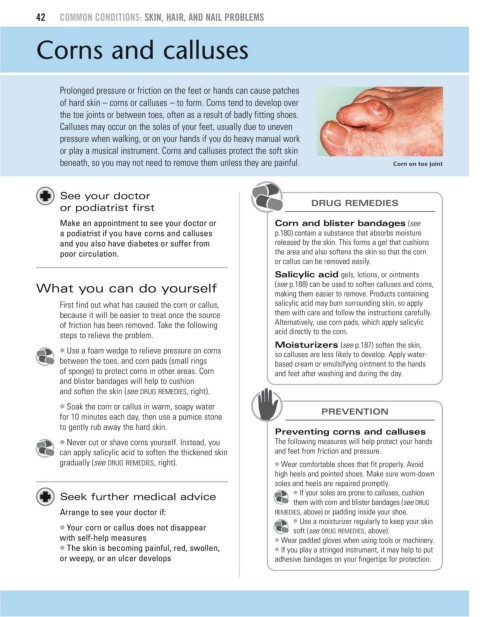
              beneath, so you may not need to remove them unless they are painful.    Corn on toe joint


              See your doctor
                                                                    DRUG REMEDIES
              or podiatrist first
              Make an appointment to see your doctor or     Corn and blister bandages (see
              a podiatrist if you have corns and calluses   p.180) contain a substance that absorbs moisture
              and you also have diabetes or suffer from     released by the skin. This forms a gel that cushions
              poor circulation.                             the area and also softens the skin so that the corn
                                                            or callus can be removed easily.
                                                            Salicylic acid gels, lotions, or ointments
         What you can do yourself                           (see p.188) can be used to soften calluses and corns,
                                                            making them easier to remove. Products containing
              First find out what has caused the corn or callus,  salicylic acid may burn surrounding skin, so apply
              because it will be easier to treat once the source  them with care and follow the instructions carefully.
              of friction has been removed. Take the following  Alternatively, use corn pads, which apply salicylic
              steps to relieve the problem.                 acid directly to the corn.
                                                            Moisturizers (see p.187) soften the skin,
              ● Use a foam wedge to relieve pressure on corns
                                                            so calluses are less likely to develop. Apply water-
              between the toes, and corn pads (small rings   based cream or emulsifying ointment to the hands
              of sponge) to protect corns in other areas. Corn  and feet after washing and during the day.
              and blister bandages will help to cushion
              and soften the skin (see DRUG REMEDIES, right).
              ● Soak the corn or callus in warm, soapy water
                                                                      PREVENTION
              for 10 minutes each day, then use a pumice stone
              to gently rub away the hard skin.
                                                            Preventing corns and calluses
              ● Never cut or shave corns yourself. Instead, you  The following measures will help protect your hands
              can apply salicylic acid to soften the thickened skin  and feet from friction and pressure.
              gradually (see DRUG REMEDIES, right).         ● Wear comfortable shoes that fit properly. Avoid
                                                            high heels and pointed shoes. Make sure worn-down
                                                            soles and heels are repaired promptly.
                                                                ● If your soles are prone to calluses, cushion
              Seek further medical advice
                                                                them with corn and blister bandages (see DRUG
              Arrange to see your doctor if:                REMEDIES, above) or padding inside your shoe.
                                                                ● Use a moisturizer regularly to keep your skin
              ● Your corn or callus does not disappear
                                                                soft (see DRUG REMEDIES, above).
              with self-help measures                       ● Wear padded gloves when using tools or machinery.
              ● The skin is becoming painful, red, swollen,  ● If you play a stringed instrument, it may help to put
              or weepy, or an ulcer develops                adhesive bandages on your fingertips for protection.

