


Page 45 - (DK) Home Doctor: Providing practical advice on home treatments
P. 45
COMMON CONDITIONS: SKIN, HAIR, AND NAIL PROBLEMS  43

         Warts and plantar warts


              Warts are small, round growths on the skin that have a rough, cauliflower-like appearance and, sometimes,
              tiny black spots in the center. They are caused by a virus and tend to be most common in children and young
              adults. Warts are most likely to develop on your hands or on the soles of your feet; those that occur on the
              feet are called plantar warts. Although warts do not usually hurt, plantar warts may be painful because
              walking puts pressure on them – it may feel like having a pebble in your shoe.


              See your doctor first
                                                                    DRUG REMEDIES
              Make an appointment to see your doctor if:
              ● You are not entirely certain that a new     Salicylic acid gels, lotions, or ointments
                                                            (see p.188) soften warts so that they can then be
              growth on your skin is a wart
              ● You have warts on your face or around the   removed easily. Products containing salicylic acid
                                                            can burn healthy skin, however, so you need to use
              anus or genitals: these need special treatment
                                                            them with care. Make sure that you apply them
                                                            only to the wart and not to the surrounding skin.
         What you can do yourself
              Most warts disappear eventually, but it can take   PRACTICAL TECHNIQUE
              a long time – sometimes years. Prompt treatment
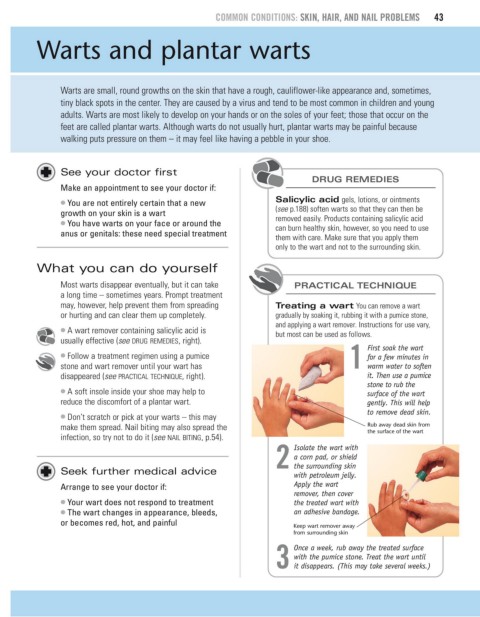
              may, however, help prevent them from spreading  Treating a wart You can remove a wart
              or hurting and can clear them up completely.   gradually by soaking it, rubbing it with a pumice stone,
                                                            and applying a wart remover. Instructions for use vary,
              ● A wart remover containing salicylic acid is
                                                            but most can be used as follows.
              usually effective (see DRUG REMEDIES, right).
                                                                                First soak the wart
              ● Follow a treatment regimen using a pumice                       for a few minutes in
              stone and wart remover until your wart has                    1 warm water to soften
              disappeared (see PRACTICAL TECHNIQUE, right).                     it. Then use a pumice
                                                                                stone to rub the
              ● A soft insole inside your shoe may help to
                                                                                surface of the wart
              reduce the discomfort of a plantar wart.                          gently. This will help
                                                                                to remove dead skin.
              ● Don’t scratch or pick at your warts – this may
              make them spread. Nail biting may also spread the                 Rub away dead skin from
                                                                                the surface of the wart
              infection, so try not to do it (see NAIL BITING, p.54).
                                                                Isolate the wart with
                                                                a corn pad, or shield
                                                            2 the surrounding skin
              Seek further medical advice
                                                                with petroleum jelly.
              Arrange to see your doctor if:                    Apply the wart
                                                                remover, then cover
              ● Your wart does not respond to treatment         the treated wart with
              ● The wart changes in appearance, bleeds,         an adhesive bandage.
              or becomes red, hot, and painful
                                                                Keep wart remover away
                                                                from surrounding skin
                                                                Once a week, rub away the treated surface
                                                                with the pumice stone. Treat the wart until
                                                            3 it disappears. (This may take several weeks.)

