


Page 124 - (DK Eyewitness) Travel Guide - Rome
P. 124
122 ROME AREA B Y AREA
1 Fontana dei in the 17th century with the
Quattro Fiumi addition of the Fontana dei
Quattro Fiumi. The other
Piazza Navona. Map 4 E4 & 11 C3. fountains date from the
@ 46, 62, 64, 70, 81, 87, 116, 492, 628. pre vious century but have
been altered several times
Built for Pope Innocent X since. The basin of the Fontana
Pamphilj, this magnificent di Nettuno, at the northern
fountain in the center of Piazza end, was built by Giacomo
Navona was unveiled in 1651. della Porta in 1576, while the
The pope’s coat of arms, the statues of Neptune and the
dove and the olive branch, Nereids date from the 19th
decorate the pyramid rock century. The Fontana del
formation supporting the Moro, at the southern end,
Roman obelisk, which once was also designed by della
stood in the Circus of Maxentius Porta, though Bernini altered
on the Appian Way. Bernini it later, adding a statue of a
designed the fountain, which Palazzo Pamphilj, the largest building in Moor fighting a dolphin.
was paid for by means of taxes Piazza Navona Up until the 19th century,
on bread and other staples. The Piazza Navona was flooded
great rivers – the Ganges, the 2 Piazza Navona during August by plugging
Danube, the Nile, and the Map 4 E3 & 11 C2. @ 46, 62, 64, 70, the fountain outlets. The
Plate – are represented by 81, 87, 116, 492, 628. rich would splash around in
four giants. The Nile’s veiled carriages, while street urchins
head symbolizes the river’s The most beautiful Baroque paddled after them. Today, with
unknown source, but there is piazza in the city follows the its numerous stores and cafés,
also a legend that the veil shape of Domitian’s Stadium, the piazza is a favorite in all
conveys Bernini’s dislike for the which once stood on this site – seasons. In summer it is busy
nearby Sant’Agnese in Agone, some of its arches are still with street entertainers, while
designed by his rival Borromini. visible below the church of in winter it fills with colorful
Similarly, the athletic figure of Sant’Agnese in Agone. The stands selling toys and candy
the Plate, cringing with arm agones were athletic contests for the feast of the Befana.
upraised, is supposed to held in the 1st-century
express Bernini’s fear that the stadium, which could seat
church will collapse. Sadly, as many as 33,000 people.
these widely believed stories The word “Navona” is
can have no basis in fact: thought to be a corruption
Bernini had completed the of in agone. The piazza’s
fountain before Borromini unique appearance and
started work on the church. atmosphere were created
Coat of arms with dove and olive branch
on the facade of Palazzo Pamphilj
3 Palazzo Pamphilj
Piazza Navona. Map 4 E4 & 11 C3.
@ 46, 62, 64, 70, 81, 87, 116, 492, 628.
Closed to the public.
In 1644 Giovanni Battista
Pamphilj became Pope
Innocent X. During his 10-year
reign, he heaped riches on his
own family, especially his
domineering sister-in-law,
Olimpia Maidalchini. The “talking
statue” Pasquino (see p126) gave
her the nickname “Olim-Pia,”
Latin for “formerly virtuous.”
She lived in the grand Palazzo
Pamphilj, which has frescoes
by Pietro da Cortona and a
gallery by Borromini. The
building is now the Brazilian
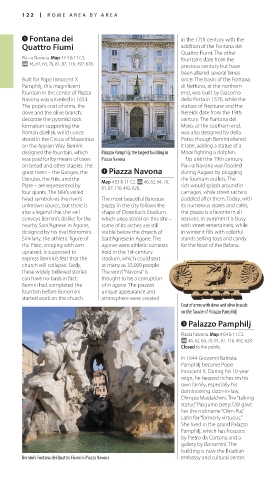
Bernini’s Fontana dei Quattro Fiumi in Piazza Navona embassy and cultural center.
US_122-123_EW_Rome_US.indd 122 15/03/17 4:20 pm

