


Page 157 - (DK Eyewitness) Travel Guide - Rome
P. 157
C A MPO DE ’ FIORI 155
l San Giovanni dei
Fiorentini
Via Acciaioli 2. Map 4 D4 & 11 A2.
Tel 06-6889 2059. @ 23, 40, 46, 62,
64, 116, 280, 870. Open 7:25am–noon
& 5–7pm daily. 5
The church of St. John of the
Florentines was built for the
large Florentine community
living in this area. Pope Leo X
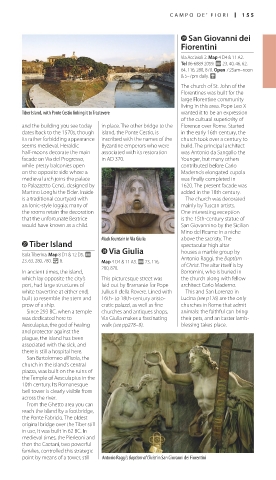
Tiber Island, with Ponte Cestio linking it to Trastevere wanted it to be an expression
of the cultural superiority of
and the building you see today in place. The other bridge to the Florence over Rome. Started
dates back to the 1570s, though island, the Ponte Cestio, is in the early 16th century, the
its rather forbidding appearance inscribed with the names of the church took over a century to
seems medieval. Heraldic Byzantine emperors who were build. The principal architect
half-moons decorate the main associated with its restoration was Antonio da Sangallo the
facade on Via del Progresso, in AD 370. Younger, but many others
while pretty balconies open contributed before Carlo
on the opposite side where a Maderno’s elongated cupola
medieval arch joins the palace was finally completed in
to Palazzetto Cenci, designed by 1620. The present facade was
Martino Longhi the Elder. Inside added in the 18th century.
is a traditional courtyard with The church was decorated
an Ionic-style loggia; many of mainly by Tuscan artists.
the rooms retain the decoration One interesting exception
that the unfortunate Beatrice is the 15th-century statue of
would have known as a child. San Giovannino by the Sicilian
Mino del Reame in a niche
Mask fountain in Via Giulia above the sacristy. The
j Tiber Island spectacular high altar
k Via Giulia houses a marble group by
Isola Tiberina. Map 8 D1 & 12 D5. @
23, 63, 280, 780. v 8. Map 4 D4 & 11 A3. @ 23, 116, Antonio Raggi, the Baptism
280, 870. of Christ. The altar itself is by
In ancient times, the island, Borromini, who is buried in
which lay opposite the city’s This picturesque street was the church along with fellow
port, had large structures of laid out by Bramante for Pope architect Carlo Maderno.
white travertine at either end, Julius II della Rovere. Lined with This and San Lorenzo in
built to resemble the stern and 16th- to 18th-century aristo- Lucina (see p116) are the only
prow of a ship. cratic palazzi, as well as fine churches in Rome that admit
Since 293 BC, when a temple churches and antiques shops, animals: the faithful can bring
was dedicated here to Via Giulia makes a fascinating their pets, and an Easter lamb-
Aesculapius, the god of healing walk (see pp278–9). blessing takes place.
and protector against the
plague, the island has been
associated with the sick, and
there is still a hospital here.
San Bartolomeo all’Isola, the
church in the island’s central
piazza, was built on the ruins of
the Temple of Aesculapius in the
10th century. Its Romanesque
bell tower is clearly visible from
across the river.
From the Ghetto area you can
reach the island by a footbridge,
the Ponte Fabricio. The oldest
original bridge over the Tiber still
in use, it was built in 62 BC. In
medieval times, the Pierleoni and
then the Caetani, two powerful
families, controlled this strategic
point by means of a tower, still Antonio Raggi’s Baptism of Christ in San Giovanni dei Fiorentini
US_154-155_EW_Rome_US.indd 155 16/03/17 11:55 am

