


Page 152 - (DK Eyewitness) Travel Guide - Rome
P. 152
150 ROME AREA B Y AREA
illustration of the spirit of the
Baroque age. All architectural
elements are concealed so that
the space of the chapel’s interior
is defined solely by decorative
marblework and statues. Veined
jasper and precious multicolored
marbles are sculpted to imitate
flowery damask and velvet
hangings. Even the altar rail
is a long swag of jasper drapery
held up by a pair of kneeling
angels with wooden wings.
Although there are
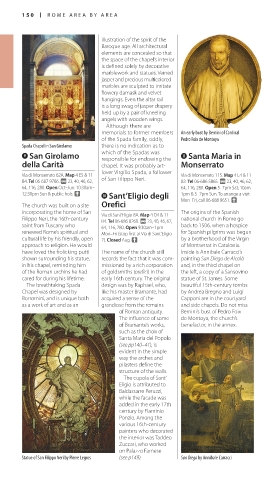
memorials to former members An early bust by Bernini of Cardinal
of the Spada family, oddly, Pedro Foix de Montoya
Spada Chapel in San Girolamo there is no indication as to
9 San Girolamo which of the Spadas was q Santa Maria in
responsible for endowing the
della Carità chapel. It was probably art- Monserrato
lover Virgilio Spada, a follower
Via di Monserrato 62A. Map 4 E5 & 11 Via di Monserrato 115. Map 4 E4 & 11
B4. Tel 06-687 9786. @ 23, 40, 46, 62, of San Filippo Neri. B3. Tel 06-686 5865. @ 23, 40, 46, 62,
64, 116, 280. Open Oct–Jun: 10:30am– 64, 116, 280. Open 5–7pm Sat; 10am–
12:30pm Sun & public hols. 5 0 Sant’Eligio degli 1pm & 5–7pm Sun. To arrange a visit
The church was built on a site Orefici Mon–Fri, call 06-688 9651. 5
incorporating the home of San Via di Sant’Eligio 8A. Map 4 D4 & 11 The origins of the Spanish
Filippo Neri, the 16th-century B4. Tel 06-686 8260. @ 23, 40, 46, 62, national church in Rome go
saint from Tuscany who 64, 116, 280. Open 9:30am–1pm back to 1506, when a hospice
renewed Rome’s spiritual and Mon–Fri (stop first at Via di Sant’Eligio for Spanish pilgrims was begun
cultural life by his friendly, open 7). Closed Aug. 5 by a brotherhood of the Virgin
approach to religion. He would of Montserrat in Catalonia.
have loved the frolicking putti The name of the church still Inside is Annibale Carracci’s
shown surrounding his statue, records the fact that it was com- painting San Diego de Alcalà
in his chapel, reminding him missioned by a rich corporation and, in the third chapel on
of the Roman urchins he had of goldsmiths (orefici) in the the left, a copy of a Sansovino
cared for during his lifetime. early 16th century. The original statue of St. James. Some
The breathtaking Spada design was by Raphael, who, beautiful 15th-century tombs
Chapel was designed by like his master Bramante, had by Andrea Bregno and Luigi
Borromini, and is unique both acquired a sense of the Capponi are in the courtyard
as a work of art and as an grandiose from the remains and side chapels. Do not miss
of Roman antiquity. Bernini’s bust of Pedro Foix
The influence of some de Montoya, the church’s
of Bramante’s works, benefactor, in the annex.
such as the choir of
Santa Maria del Popolo
(see pp140–41), is
evident in the simple
way the arches and
pilasters define the
structure of the walls.
The cupola of Sant’
Eligio is attributed to
Baldassarre Peruzzi,
while the facade was
added in the early 17th
century by Flaminio
Ponzio. Among the
various 16th-century
painters who decorated
the interior was Taddeo
Zuccari, who worked
on Palazzo Farnese
Statue of San Filippo Neri by Pierre Legros (see p149). San Diego by Annibale Carracci
US_150-151_EW_Rome_US.indd 150 15/03/17 4:20 pm
Eyewitness Travel LAYERS PRINTED:
Catalogue template “UK” LAYER
(Source v1.9)
Date 20th August 2012
Size 125mm x 217mm

