


Page 156 - (DK Eyewitness) Travel Guide - Rome
P. 156
154 ROME AREA B Y AREA
d Portico of Octavia only allowed out during the day, are embedded in the facades,
and on Sundays they were in addition to a fragment of
Via del Portico d’Ottavia. Map 4 F5 &
12 E5. @ 46, 62, 63, 64, 70, 87, 186, driven into the Church of an ancient sarcophagus. The
780, 810. Sant’Angelo in Pescheria to listen Piazza Costaguti facade’s
to Christian sermons – a practice windows are inscribed Ave
Built in honor of Octavia (the that was only abolished in 1848. Roma (Hail Rome).
sister of Augustus and the Persecution started again
abandoned wife of Mark in 1943 with the German
Antony), this is the only surviving occupation. Although many
portico of what used to be the Jews were helped to escape
monumental piazza of Circus or hidden by Roman citizens,
Flaminius. The rectangular thousands were deported to
portico enclosed temples German concentration camps.
dedicated to Jupiter and Juno, Today many Jews still reside
decorated with bronze statues. in the former Ghetto around
The part we see today is the Via del Portico d’Ottavia, and
great central atrium originally the medieval streets retain
covered by marble facings. much of their old character. The
In the Middle Ages a great fish Synagogue on Lungotevere was
market and a church, Sant’Angelo completed in 1904 and is now
in Pescheria, were built in the home to a Jewish museum that
ruins of the portico. As the describes the history of the
church was associated with the community through plans,
fishing activities of the nearby Torahs, and other artifacts.
river port, aquatic flora and fauna
feature in many of its inlays. g Casa di Lorenzo
Links with the Tiber are also
apparent in the stucco facade Manilio
on the adjacent Fishmonger’s Via del Portico d’Ottavia 1D. Map 4 F5
Oratory, built in 1689. The church & 12 D5. @ 46, 62, 63, 64, 70, 87,
has a fresco of the Madonna 186, 780, 810. Closed to the public. Balcony of Palazzo Cenci
and angels by the school of
Benozzo Gozzoli. Before the Renaissance, most h Palazzo Cenci
Romans had only vague ideas Vicolo dei Cenci. Map 4 F5 & 12 D5.
f Ghetto and of their city’s past, but the @ 23, 63, 280, 780, and routes to
15th-century revival of interest
Synagogue in the philosophy, and arts of Largo di Torre Argentina.
Closed to the public.
antiquity inspired some to build
Synagogue: Lungotevere dei Cenci.
Map 4 F5 & 12 E5. Tel 06-6840 0661. houses recalling the splendor of Palazzo Cenci belonged to the
@ 23, 63, 280, 780, and routes to ancient Rome. In 1468 a certain family of Beatrice Cenci, who
Largo di Torre Argentina. v 8. Lorenzo Manilio built a great was accused, together with
Museum: Open Apr–mid-Sep: house for his family, decorating her brothers and stepmother,
10am–6pm Sun–Thu, 10am–4pm Fri; it with an elegant Classical of witchcraft, and the murder
mid-Sep–Mar: 10am–5pm Sun–Thu, plaque. The Latin inscription of her tyrannical father. She
9am–2pm Fri. Last adm: 45 mins dates the building according to was condemned to death, and
before closing. Closed on Jewish the ancient Roman method – beheaded at Ponte Sant’Angelo
public hols. & ^ 8 = 2,221 years after the foundation in 1599.
∑ museoebraico.roma.it of the city – and gives the Most of the original medieval
owner’s name. Original reliefs palazzo has been demolished,
The first Jews came to Rome as
traders in the 2nd century BC, and
there has been a Jewish com-
munity in Rome ever since. Jews
were much appreciated for their
financial and medical skills during
the time of the Roman Empire.
Systematic persecution began
in the 16th century. From July 25,
1556, all of Rome’s Jews were
forced to live inside a high-
walled enclosure erected on the
orders of Pope Paul IV. The
Ghetto was in a damp, unhealthy
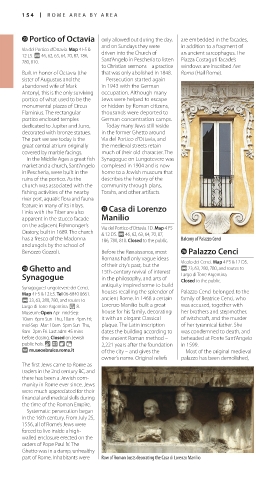
part of Rome. Inhabitants were Row of Roman busts decorating the Casa di Lorenzo Manilio
US_154-155_EW_Rome_US.indd 154 16/03/17 11:55 am
Eyewitness Travel LAYERS PRINTED:
Catalogue template w
(Source v1.9)
Date 20th August 2012
Size 125mm x 217mm

