


Page 154 - (DK Eyewitness) Travel Guide - Rome
P. 154
152 ROME AREA B Y AREA
bowl-makers’ (catinari) shops
in the area. The solemn
travertine facade was
completed in 1638 by the
Roman architect Soria. The
16th-century basilican plan
is flanked by chapels. The
St. Cecilia chapel was designed
and decorated by Antonio
Gherardi, who added a family
portrait. The church’s paintings
and frescoes by Pietro da
Detail of facade, Teatro Argentina Cortona and Guido Reni are
mature works of the Counter-
y Teatro Argentina Imperial times two marble Reformation, depicting the
lavatories were built here – the life and acts of the recently
Largo di Torre Argentina 52. Map 4 F4
& 12 D4. Tel 06-684 0001. @ 40, 46, remains of one is visible behind canonized San Carlo.
62, 64, 70, 81, 87, 186, 492, 810. v 8. temple A. Behind temples B and The ornate crucifix on
Open Museum by appt only (call C are remains of a great platform the sacristy altar is inlaid with
06-0608). &Plays performed Oct–Jun. of tufa blocks identified as part marble and mother-of-pearl
See Entertain ment pp352–3. of the Curia of Pompey – a and is by the 16th-century
∑ teatrodiroma.net rectangular building with a sculptor Algardi.
statue of Pompey. It was here
One of the city’s most influential that the Senate met and Julius
theaters was founded by the Caesar was murdered on March
Sforza Cesarini family in 1732, 15, 44 BC. At the southwest
though the facade dates from a corner of the site is a cat
century later. Many famous sanctuary, home to Rome’s
operas, including those of Verdi, abandoned felines. The ruins
were first performed here. In are closed to the public, but can
1816, the theater saw the ill- be admired from the street.
fated debut of Rossini’s Barber
of Seville, during which the i San Carlo ai
composer insulted the unap-
preciative audience, who then Catinari
pursued him through the streets. Piazza B. Cairoli. Map 4 F5 & 12 D4.
Tel 06-6830 7070. @ 40, 46, 62, 64,
u Area Sacra 70, 81, 87, 186, 492, 810. v 8.
dell’Argentina Open 7:30am–noon & 4–7pm daily.
5 No visits during services.
Largo di Torre Argentina. Map 4 F4 &
12 D4. @ 40, 46, 62, 64, 70, 81, 87, 186, In 1620, Rome’s Milanese
492, 810. v 8. Closed to the public, congregation decided to honor
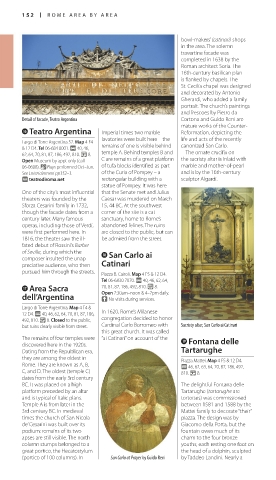
but ruins clearly visible from street. Cardinal Carlo Borromeo with Sacristy altar, San Carlo ai Catinari
this great church. It was called
The remains of four temples were “ai Catinari” on account of the o Fontana delle
discovered here in the 1920s.
Dating from the Republican era, Tartarughe
they are among the oldest in Piazza Mattei. Map 4 F5 & 12 D4.
Rome. They are known as A, B, @ 46, 62, 63, 64, 70, 87, 186, 492,
C, and D. The oldest (temple C) 810. v 8.
dates from the early 3rd century
BC. It was placed on a high The delightful Fontana delle
platform preceded by an altar Tartarughe (tartarughe are
and is typical of Italic plans. tortoises) was commissioned
Temple A is from later in the between 1581 and 1588 by the
3rd century BC. In medieval Mattei family to decorate “their”
times the church of San Nicola piazza. The design was by
de’ Cesarini was built over its Giacomo della Porta, but the
podium: remains of its two fountain owes much of its
apses are still visible. The north charm to the four bronze
column stumps belonged to a youths, each resting one foot on
great portico, the Hecato stylum the head of a dolphin, sculpted
(portico of 100 columns). In San Carlo at Prayer by Guido Reni by Taddeo Landini. Nearly a
US_152-153_EW_Rome_US.indd 152 19/04/2017 12:34
Eyewitness Travel LAYERS PRINTED:
Catalogue template “UK” LAYER
(Source v1.9)
Date 20th August 2012
Size 125mm x 217mm

