


Page 163 - (DK Eyewitness) Travel Guide - Rome
P. 163
QUIRINAL 161
late 15th-century portico. Inside
the portico on the left is
Canova’s 1807
memorial to the
engraver Giovanni
Volpato. The church itself
contains a much larger
monument by Canova, his
Tomb of Clement XIV (1789).
The Baroque interior by
Francesco and Carlo Fontana
was completed in 1714. Note
the 3-D effect of Giovanni
Odazzi’s painted Rebel Angels,
who really look as though they
are falling from the sky. A huge
18th-century altarpiece by
Domenico Muratori shows the
martyrdom of the Apostles
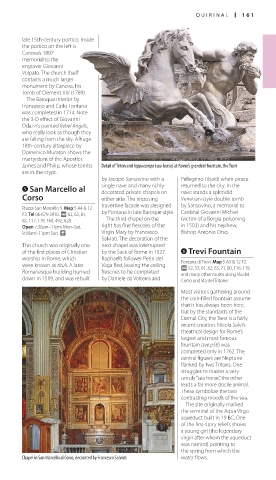
James and Philip, whose tombs Detail of Triton and hippocampo (sea horse) at Rome’s grandest fountain, the Trevi
are in the crypt.
by Jacopo Sansovino with a Pellegrino Tibaldi when peace
5 San Marcello al single nave and many richly returned to the city. In the
decorated private chapels on
nave stands a splendid
Corso either side. The imposing Venetian-style double tomb
travertine facade was designed by Sansovino, a memorial to
Piazza San Marcello 5. Map 5 A4 & 12
F3. Tel 06-679 3910. @ 62, 63, 81, by Fontana in late Baroque style. Cardinal Giovanni Michiel
85, 117, 119, 160, 492, 628. The third chapel on the (victim of a Borgia poisoning
Open 7:30am–11pm Mon–Sat, right has fine frescoes of the in 1503) and his nephew,
9:30am–11pm Sun. 5 Virgin Mary by Francesco Bishop Antonio Orso.
Salviati. The decoration of the
This church was originally one next chapel was interrupted
of the first places of Christian by the Sack of Rome in 1527. 6 Trevi Fountain
worship in Rome, which Raphael’s follower Perin del Fontana di Trevi. Map 5 A3 & 12 F2.
were known as tituli. A later Vaga fled, leaving the ceiling @ 52, 53, 61, 62, 63, 71, 80, 116, 119,
Romanesque building burned frescoes to be completed and many other routes along Via del
down in 1519, and was rebuilt by Daniele da Volterra and Corso and Via del Tritone.
Most visitors gathering around
the coin-filled fountain assume
that it has always been here,
but by the standards of the
Eternal City, the Trevi is a fairly
recent creation. Nicola Salvi’s
theatrical design for Rome’s
largest and most famous
fountain (see p56) was
completed only in 1762. The
central figures are Neptune
flanked by two Tritons. One
struggles to master a very
unruly “sea horse,” the other
leads a far more docile animal.
These symbolize the two
contrasting moods of the sea.
The site originally marked
the terminal of the Aqua Virgo
aqueduct built in 19 BC. One
of the first-story reliefs shows
a young girl (the legendary
virgin after whom the aqueduct
was named) pointing to
the spring from which the
Chapel in San Marcello al Corso, decorated by Francesco Salviati water flows.
US_160-161_EW_Rome_US.indd 161 15/03/17 4:20 pm

