


Page 165 - (DK Eyewitness) Travel Guide - Rome
P. 165
QUIRINAL 163
w San Carlo alle
Quattro Fontane
Via del Quirinale 23. Map 5 B3.
Tel 06-488 3261. @ 116, 117 & routes
to Piazza Barberini. q Barberini.
Open 10am–1pm, 3–6pm Mon–Fri
(mornings only Jul & Aug); 10am–1pm
Sat, 10am–1pm Sun. 5
In 1634, the Trinitarians, a Spanish
order whose role was to pay the
ransom of Christian hostages
to the Arabs, commissioned
Borromini to design a church
and convent at the Quattro
Fontane crossroads. The church,
so small it would fit inside one
of the piers of St. Peter’s, is also
known as “San Carlino.”
Although dedicated to Carlo
Borromeo, the 16th-century
Milanese cardinal canonized
in 1620, San Carlo is as much a
monument to Borromini. Both
the facade and interior employ
bold curves that give light and
life to a small, cramped site.
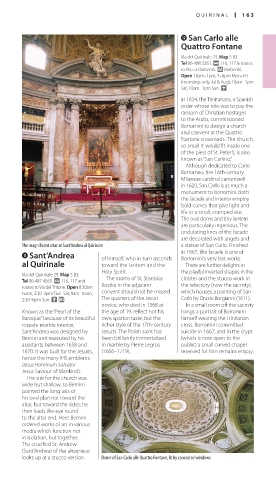
The oval dome and tiny lantern
are particularly ingenious. The
undulating lines of the facade
are decorated with angels and
The magnificent altar at Sant’Andrea al Quirinale a statue of San Carlo. Finished
q Sant’Andrea of himself, who in turn ascends in 1667, the facade is one of
Borromini’s very last works.
al Quirinale toward the lantern and the There are further delights in
Holy Spirit. the playful inverted shapes in the
Via del Quirinale 29. Map 5 B3.
Tel 06-487 4565. @ 116, 117 and The rooms of St. Stanislas cloister and the stucco work in
routes to Via del Tritone. Open 8:30am– Kostka in the adjacent the refectory (now the sacristy),
noon, 2:30–6pm Tue–Sat, 9am–noon, convent should not be missed. which houses a painting of San
2:30–6pm Sun. 5 ^ The quarters of the Jesuit Carlo by Orazio Borgianni (1611).
novice, who died in 1568 at In a small room off the sacristy
Known as the “Pearl of the the age of 19, reflect not his hangs a portrait of Borromini
Baroque” because of its beautiful own spartan taste, but the himself wearing the Trinitarian
roseate marble interior, richer style of the 17th-century cross. Borromini committed
Sant’Andrea was designed by Jesuits. The Polish saint has suicide in 1667, and in the crypt
Bernini and executed by his been brilliantly immortalized (which is now open to the
assistants between 1658 and in marble by Pierre Legros public) a small curved chapel
1670. It was built for the Jesuits, (1666–1719). reserved for him remains empty.
hence the many IHS emblems
(Iesus Hominum Salvator –
Jesus Saviour of Mankind).
The site for the church was
wide but shallow, so Bernini
pointed the long axis of
his oval plan not toward the
altar, but toward the sides; he
then leads the eye round
to the altar end. Here Bernini
ordered works of art in various
media which function not
in isolation, but together.
The crucified St. Andrew
(Sant’Andrea) of the altarpiece
looks up at a stucco version Dome of San Carlo alle Quattro Fontane, lit by concealed windows
162-163_EW_Rome_US.indd 163 15/03/17 3:45 pm

