


Page 167 - (DK Eyewitness) Travel Guide - Rome
P. 167
QUIRINAL 165
belonged to Sixtus V, used to cypresses, oleanders, roses,
be a Jesuit college. In 1981–97 poppies, and irises are all clearly
it was restored to house a distinguishable. Other marvels
significant proportion of the include rooms brought from
museum’s collections. The the first Villa Farnesina: the
exhibits, contained on four children’s room has a pre-
stories, are originals dating from dominantly white design,
the 2nd century BC to the end while the adults’ bedroom is
of the 4th century AD. red, complete with erotic
The basement contains an paintings. Equally impressive
excellent display of ancient is the museum’s display of
coins, precious artifacts, and mosaics on the same floor.
the only mummified child to
be found in the ancient city. u Baths of
The first floor is devoted to
Roman statuary, with funeral Diocletian
monuments in Room 2 and Terme di Diocleziano, Viale E de Nicola
Emperor Augustus in Pontifex 79. Map 6 D3. Tel 06-3996 7700.
Maximus guise in Room 5. @ 36, 60, 61, 62, 90. q Repubblica,
Upstairs there are statues from Termini. Open 9am–7:30pm Tue–Sun
Nero’s summer villa in Anzio (last adm: 6:45pm). Closed Jan 1, Dec
and Roman copies of famous 25. & (the biglietto cumulativo gives
Greek originals, such as the entry to the museum’s five branches).
Discobolos Ex-Lancellotti.
The real joy of the museum, Built in AD 298–306 under the
however, is on the third story, infamous Emperor Diocletian,
where entire rooms of wall who murdered thousands of
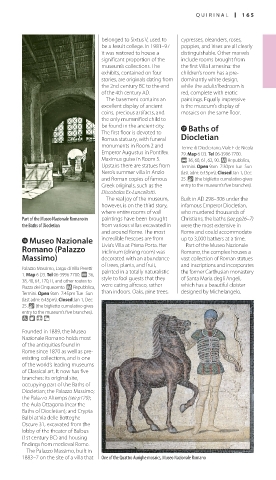
Part of the Museo Nazionale Romano in paintings have been brought Christians, the baths (see pp26–7)
the Baths of Diocletian from various villas excavated in were the most extensive in
and around Rome. The most Rome and could accommodate
y Museo Nazionale incredible frescoes are from up to 3,000 bathers at a time.
Romano (Palazzo Livia’s Villa at Prima Porta. Her Part of the Museo Nazionale
Romano, the complex houses a
triclinium (dining room) was
Massimo) decorated with an abundance vast collection of Roman statues
of trees, plants, and fruit, and inscriptions and incorporates
Palazzo Massimo, Largo di Villa Peretti painted in a totally naturalistic
1. Map 6 D3. Tel 06-3996 7700. @ 36, the former Carthusian monastery
38, 40, 64, 170, H, and other routes to style to fool guests that they of Santa Maria degli Angeli,
Piazza dei Cinquecento. q Repubblica, were eating alfresco, rather which has a beautiful cloister
Termini. Open 9am–7:45pm Tue–Sun than indoors. Oaks, pine trees, designed by Michelangelo.
(last adm: 6:45pm). Closed Jan 1, Dec
25. & (the biglietto cumulativo gives
entry to the museum’s five branches).
7 8 9 =
Founded in 1889, the Museo
Nazionale Romano holds most
of the antiquities found in
Rome since 1870 as well as pre-
existing collections, and is one
of the world’s leading museums
of Classical art. It now has five
branches: its original site,
occupying part of the Baths of
Diocletian; the Palazzo Massimo;
the Palazzo Altemps (see p129);
the Aula Ottagona (near the
Baths of Diocletian); and Crypta
Balbi at Via delle Botteghe
Oscure 31, excavated from the
lobby of the theater of Balbus
(1st century BC) and housing
findings from medieval Rome.
The Palazzo Massimo, built in
1883–7 on the site of a villa that One of the Quattro Aurighe mosaics, Museo Nazionale Romano
US_164-165_EW_Rome_US.indd 165 15/03/17 4:20 pm

