


Page 189 - (DK Eyewitness) Travel Guide - Rome
P. 189
LA TER AN 187
0 Museo Storico
della Liberazione
di Roma
Via Tasso 145. Map 9 C1. Tel 06-700
3866. q Manzoni, San Giovanni. v 3.
Open 3:30–7:30pm Tue, Thu & Fri;
9:30am–12:30pm Tue–Sun. Closed Aug.
This museum, dedicated to
the resistance to the Nazi
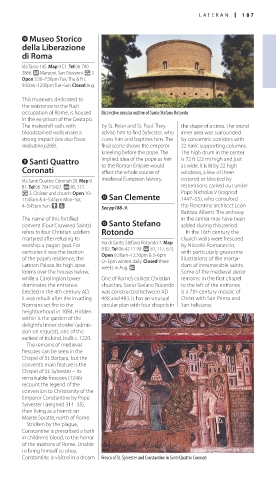
occupation of Rome, is housed Distinctive circular outline of Santo Stefano Rotondo
in the ex-prison of the Gestapo.
The makeshift cells with by St. Peter and St. Paul. They the shape of a cross. The round
bloodstained walls make a advise him to find Sylvester, who inner area was surrounded
strong impact (see also Fosse cures him and baptizes him. The by concentric corridors with
Ardeatine p268). final scene shows the emperor 22 Ionic supporting columns.
kneeling before the pope. The The high drum in the center
q Santi Quattro implied idea of the pope as heir is 72 ft (22 m) high and just
to the Roman Empire would
Coronati affect the whole course of as wide. It is lit by 22 high
windows, a few of them
Via Santi Quattro Coronati 20. Map 9 medieval European history. restored or blocked by
B1. Tel 06-7047 5427. @ 85, 117. restorations carried out under
v 3. Cloister and church: Open 10– Pope Nicholas V (reigned
11:45am & 4–5:45pm Mon–Sat, w San Clemente 1447–55), who consulted
4–5:45pm Sun. 5 7 See pp188–9. the Florentine architect Leon
Battista Alberti. The archway
The name of this fortified in the center may have been
convent (Four Crowned Saints) e Santo Stefano added during this period.
refers to four Christian soldiers Rotondo In the 16th century the
martyred after refusing to church walls were frescoed
worship a pagan god. For Via di Santo Stefano Rotondo 7. Map by Niccolò Pomarancio,
9 B2. Tel 06-42 11 99. @ 81, 117, 673.
centuries it was the bastion Open 9:30am–12:30pm & 3–6pm with particularly gruesome
of the pope’s residence, the (2–5pm winter) daily. Closed three illustrations of the martyr -
Lateran Palace. Its high apse weeks in Aug. ^ dom of innumerable saints.
looms over the houses below, Some of the medieval decor
while a Carolingian tower One of Rome’s earliest Christian remains: in the first chapel
dominates the entrance. churches, Santo Stefano Rotondo to the left of the entrance
Erected in the 4th century AD, was con structed between AD is a 7th-century mosaic of
it was rebuilt after the invading 468 and 483. It has an unusual Christ with San Primo and
Normans set fire to the circular plan with four chapels in San Feliciano.
neighborhood in 1084. Hidden
within is the garden of the
delightful inner cloister (admis-
sion on request), one of the
earliest of its kind, built c. 1220.
The remains of medieval
frescoes can be seen in the
Chapel of St. Barbara, but the
convent’s main feature is the
Chapel of St. Sylvester – its
remarkable frescoes (1246)
recount the legend of the
conversion to Christianity of the
Emperor Constantine by Pope
Sylvester I (reigned 314–35),
then living as a hermit on
Monte Soratte, north of Rome.
Stricken by the plague,
Constantine is prescribed a bath
in children’s blood, to the horror
of the matrons of Rome. Unable
to bring himself to obey,
Constantine is visited in a dream Fresco of St. Sylvester and Constantine in Santi Quattro Coronati
US_186-187_EW_Rome_US.indd 187 15/03/17 4:20 pm

