


Page 288 - (DK Eyewitness) Travel Guide - Rome
P. 288
286 ROME AREA B Y AREA
0 A 90-Minute Walk Along the Via Appia Antica
Lined with cypresses and pines as it was when the ancient
Romans came here by torchlight to bury their dead, the Via
Appia is wonderfully atmospheric. The fields are strewn with
ruined tombs set against the picturesque background of the
Alban hills to the south. Although the marble or travertine
stone facings of most tombs have been plundered, a few
statues and reliefs survive or have been replaced by copies.
Capo di Bove 9 Tomb of Sixtus Pompeus
Start from the the Righteous
Tomb of Cecilia 1
Metella 1 (see p268).
In the Middle Ages, 2 VIA C. METELLA
this area acquired
the name Capo di 3
Bove (ox head)
from the frieze of
festoons and ox 4
heads still visible
VIA DEI METELLI
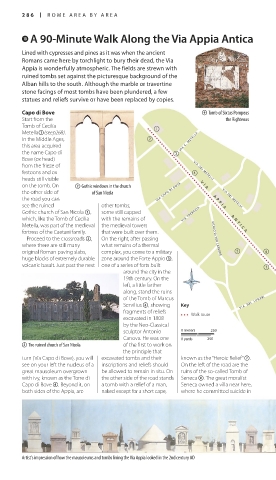
on the tomb. On 2 Gothic windows in the church
the other side of of San Nicola VIA CAPO DI BOVE
the road you can VIA DEI METELLI
see the ruined other tombs, V I A A P P I A A N T I C A
Gothic church of San Nicola 2, some still capped VIA TREBAZIA
which, like the Tomb of Cecilia with the remains of
Metella, was part of the medieval the medieval towers
fortress of the Caetani family. that were built over them.
Proceed to the crossroads 3, On the right, after passing VICOLO DI TOR CARBONE
where there are still many what remains of a thermal
original Roman paving slabs, complex, you come to a military 5 6
huge blocks of extremely durable zone around the Forte Appio 5,
volcanic basalt. Just past the next one of a series of forts built 7
around the city in the 8
19th century. On the 9
left, a little farther q
along, stand the ruins 0 V I A D E L T R O P I O
of the Tomb of Marcus w VIA DEI CARVILLI
Servilius 6, showing Key VIA DEI LUGARI e
fragments of reliefs Walk route V I A A P P I A A N T I C A
r
excavated in 1808 t
by the Neo-Classical
sculptor Antonio 0 meters 250 VIA DEGLI EUGENII y VIA P. ATTICO
Canova. He was one 0 yards 250 u
2 The ruined church of San Nicola of the first to work on V I A E R O D E AT T IC O
the principle that
turn (Via Capo di Bove), you will excavated tombs and their known as the “Heroic Relief” 7. i
see on your left the nucleus of a inscriptions and reliefs should On the left of the road are the o
great mausoleum overgrown be allowed to remain in situ. On ruins of the so-called Tomb of
with ivy, known as the Torre di the other side of the road stands Seneca 8. The great moralist V IA DI T OR CARBON E
Capo di Bove 4. Beyond it, on a tomb with a relief of a man, Seneca owned a villa near here,
both sides of the Appia, are naked except for a short cape, where he committed suicide in
Artist’s impression of how the mausoleums and tombs lining the Via Appia looked in the 2nd century AD
US_286-287_EW_Rome_US.indd 286 15/03/17 4:21 pm
Eyewitness Travel LAYERS PRINTED:
Catalogue template “UK” LAYER
(Source v1.9)
Date 20th August 2012
Size 125mm x 217mm

