


Page 18 - ClayCraft - Issue 35 (January 2020)
P. 18
Re-firing
Linda Bloomfield is a scientist
turned potter. More glaze recipes
can be found in her books,
Advanced Pottery (2011), Colour
in Glazes (A&C Black 2012), The
Handbook of Glaze Recipes
(Bloomsbury 2014) and Science
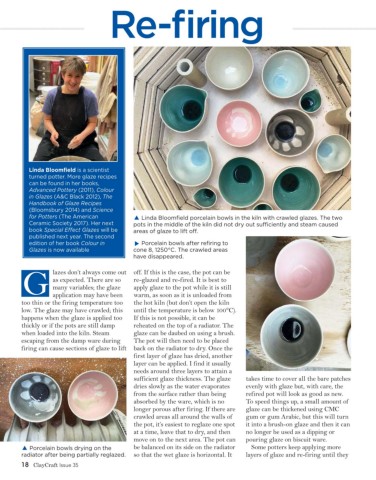
for Potters (The American Linda Bloomfield porcelain bowls in the kiln with crawled glazes. The two
Ceramic Society 2017). Her next pots in the middle of the kiln did not dry out suciently and steam caused
book Special E ect Glazes will be areas of glaze to lift o.
published next year. The second
edition of her book Colour in Porcelain bowls after refiring to
Glazes is now available cone 8, 1250°C. The crawled areas
have disappeared.
G lazes don’t always come out off. If this is the case, the pot can be
as expected. There are so
re-glazed and re-fired. It is best to
apply glaze to the pot while it is still
many variables; the glaze
application may have been warm, as soon as it is unloaded from
too thin or the firing temperature too the hot kiln (but don’t open the kiln
low. The glaze may have crawled; this until the temperature is below 100°C).
happens when the glaze is applied too If this is not possible, it can be
thickly or if the pots are still damp reheated on the top of a radiator. The
when loaded into the kiln. Steam glaze can be daubed on using a brush.
escaping from the damp ware during The pot will then need to be placed
firing can cause sections of glaze to lift back on the radiator to dry. Once the
first layer of glaze has dried, another
layer can be applied. I find it usually
needs around three layers to attain a
sufficient glaze thickness. The glaze takes time to cover all the bare patches
dries slowly as the water evaporates evenly with glaze but, with care, the
from the surface rather than being refired pot will look as good as new.
absorbed by the ware, which is no To speed things up, a small amount of
longer porous after firing. If there are glaze can be thickened using CMC
crawled areas all around the walls of gum or gum Arabic, but this will turn
the pot, it’s easiest to reglaze one spot it into a brush-on glaze and then it can
at a time, leave that to dry, and then no longer be used as a dipping or
move on to the next area. The pot can pouring glaze on biscuit ware.
Porcelain bowls drying on the be balanced on its side on the radiator Some potters keep applying more
radiator after being partially reglazed. so that the wet glaze is horizontal. It layers of glaze and re-firing until they
18 ClayCraft Issue 35

