


Page 19 - ClayCraft - Issue 35 (January 2020)
P. 19
GLAZING
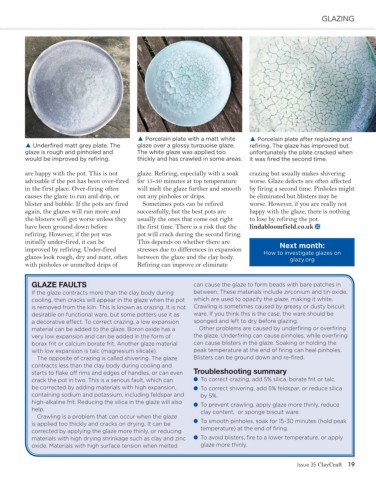
Porcelain plate with a matt white Porcelain plate after reglazing and
Underfired matt grey plate. The glaze over a glossy turquoise glaze. refiring. The glaze has improved but
glaze is rough and pinholed and The white glaze was applied too unfortunately the plate cracked when
would be improved by refiring. thickly and has crawled in some areas. it was fired the second time.
are happy with the pot. This is not glaze. Refiring, especially with a soak crazing but usually makes shivering
advisable if the pot has been over-fired for 15-30 minutes at top temperature worse. Glaze defects are often affected
in the first place. Over-firing often will melt the glaze further and smooth by firing a second time. Pinholes might
causes the glaze to run and drip, or out any pinholes or drips. be eliminated but blisters may be
blister and bubble. If the pots are fired Sometimes pots can be refired worse. However, if you are really not
again, the glazes will run more and successfully, but the best pots are happy with the glaze, there is nothing
the blisters will get worse unless they usually the ones that come out right to lose by refiring the pot.
have been ground down before the first time. There is a risk that the lindabloomfield.co.uk
refiring. However, if the pot was pot will crack during the second firing.
initially under-fired, it can be This depends on whether there are Next month:
improved by refiring. Under-fired stresses due to differences in expansion
How to investigate glazes on
glazes look rough, dry and matt, often between the glaze and the clay body.
glazy.org
with pinholes or unmelted drips of Refiring can improve or eliminate
GLAZE FAULTS can cause the glaze to form beads with bare patches in
If the glaze contracts more than the clay body during between. These materials include zirconium and tin oxide,
cooling, then cracks will appear in the glaze when the pot which are used to opacify the glaze, making it white.
is removed from the kiln. This is known as crazing. It is not Crawling is sometimes caused by greasy or dusty biscuit
desirable on functional ware, but some potters use it as ware. If you think this is the case, the ware should be
a decorative e ect. To correct crazing, a low expansion sponged and left to dry before glazing.
material can be added to the glaze. Boron oxide has a Other problems are caused by underfiring or overfiring
very low expansion and can be added in the form of the glaze. Underfiring can cause pinholes, while overfiring
borax frit or calcium borate frit. Another glaze material can cause blisters in the glaze. Soaking or holding the
with low expansion is talc (magnesium silicate). peak temperature at the end of firing can heal pinholes.
The opposite of crazing is called shivering. The glaze Blisters can be ground down and re-fired.
contracts less than the clay body during cooling and
starts to flake o rims and edges of handles, or can even Troubleshooting summary
crack the pot in two. This is a serious fault, which can ● To correct crazing, add 5% silica, borate frit or talc.
be corrected by adding materials with high expansion, ● To correct shivering, add 5% feldspar, or reduce silica
containing sodium and potassium, including feldspar and by 5%.
high-alkaline frit. Reducing the silica in the glaze will also ● To prevent crawling, apply glaze more thinly, reduce
help. clay content, or sponge biscuit ware.
Crawling is a problem that can occur when the glaze
is applied too thickly and cracks on drying. It can be ● To smooth pinholes, soak for 15-30 minutes (hold peak
temperature) at the end of firing.
corrected by applying the glaze more thinly, or reducing
materials with high drying shrinkage such as clay and zinc ● To avoid blisters, fire to a lower temperature, or apply
oxide. Materials with high surface tension when melted glaze more thinly.
Issue 35 ClayCraft 19

