


Page 27 - All About History - Issue 56-17
P. 27
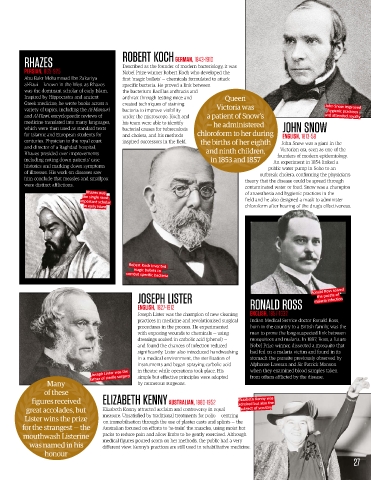
RHAZES                            ROBERT KOCH GERMAN, 1843-1910
                                            Described as the founder of modern bacteriology, it was
          PERSIAN, 865-925                  Nobel Prize-winner Robert Koch who developed the
          Abu Bakr Mohammad Ibn Zakariya    first ‘magic bullets’ — chemicals formulated to attack
          al-Razi — known in the West as Rhazes —   specific bacteria. He proved a link between
          was the dominant scholar of early Islam.   the bacterium Bacillus anthracis and
          Inspired by Hippocrates and ancient   anthrax through testing mice and   Queen
          Greek medicine, he wrote books across a   created techniques of staining
          variety of topics, including the Al-Mansuri   bacteria to improve visibility   Victoria was              John Snow improved
                                                                                                                    hygienic practices
          and Al-Hawi, encyclopaedic reviews of   under the microscope. Koch and   a patient of Snow’s             and attended royalty
          medicine translated into many languages,   his team were able to identify   — he administered
          which were then used as standard texts   bacterial causes for tuberculosis                JOHN SNOW
          for Islamic and European students for   and cholera, and his methods   chloroform to her during   ENGLISH, 1813-58
          centuries. Physician to the royal court   inspired successors in the field.  the births of her eighth   John Snow was a giant in the
          and director of a Baghdad hospital,                                                       Victorian era, seen as one of the
          Rhazes presided over improvements                              and ninth children,       founders of modern epidemiology.
          including noting down patients’ case                             in 1853 and 1857      An experiment in 1854 linked a
          histories and marking down symptoms
                                                                                               public water pump in Soho to an
          of illnesses. His work on diseases saw
                                                                                            outbreak cholera, confirming the physician’s
          him conclude that measles and smallpox
                                                                                       theory that the disease could be spread through
          were distinct afflictions.
                                                                                       contaminated water or food. Snow was a champion
                               Rhazes was                                              of anaesthesia and hygienic practices in the
                              the single most
                                                                                       field and he also designed a mask to administer
                             important scholar
                              in early Islam                                           chloroform after hearing of the drug’s effectiveness.


                                              Robert Koch invented
                                                magic bullets to
                                             combat specific bacteria

                                                                                                              Ronald Ross solved
                                                 JOSEPH LISTER                                                  malaria infection
                                                                                                                the puzzle of
                                                 ENGLISH, 1827-1912                      RONALD ROSS
                                                 Joseph Lister was the champion of new cleaning   ENGLISH, 1857-1932
                                                 practices in medicine and revolutionised surgical   Indian Medical Service doctor Ronald Ross,
                                                 procedures in the process. He experimented   born in the country to a British family, was the
                                                 with exposing wounds to chemicals — using   man to prove the long-suspected link between
                                                 dressings soaked in carbolic acid (phenol) —   mosquitoes and malaria. In 1897, Ross, a future
                                                 and found the chances of infection reduced   Nobel Prize winner, dissected a mosquito that
                                                 significantly. Lister also introduced handwashing   had fed on a malaria victim and found in its
                                                 in a medical environment, the sterilisation of   stomach the parasite previously observed by
                                                 instruments and began spraying carbolic acid    Alphonse Laveran and Sir Patrick Manson
                                 Joseph Lister was the   in theatre while operations took place. His   when they examined blood samples taken
                                 father of sterile surgery  simple but effective principles were adopted    from others afflicted by the disease.
                  Many                           by numerous surgeons.
                 of these
            figures received         ELIZABETH KENNY AUSTRALIAN, 1880-1952           Elizabeth Kenny was
                                                                                     admired but also the
          great accolades, but       Elizabeth Kenny attracted acclaim and controversy in equal   subject of scrutiny
                                     measure. Unsatisfied by traditional treatments for polio — centring
          Lister wins the prize      on immobilisation through the use of plaster casts and splints — the
         for the strangest — the     Australian focused on efforts to ‘re-train’ the muscles, using moist hot
         mouthwash Listerine         packs to reduce pain and allow limbs to be gently exercised. Although
                                     medical figures poured scorn on her methods, the public had a very
           was named in his          different view. Kenny’s practices are still used in rehabilitative medicine.             © Alamy
                 honour
                                                                                                                             27

