


Page 22 - All About History - Issue 56-17
P. 22
EpidEmics


         Day in the life


        A US ARMY MEDIC


        FIGHTING SPANISH FLU


        UNITED   STATES,   OCTOBER    1918


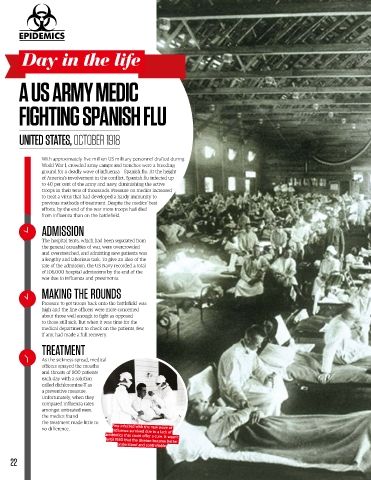
                With approximately five million US military personnel drafted during
                World War I, crowded army camps and trenches were a breeding
                ground for a deadly wave of influenza – Spanish flu. At the height
                of America’s involvement in the conflict, Spanish flu infected up
                to 40 per cent of the army and navy, diminishing the active
                troops in their tens of thousands. Pressure on medics increased
                to treat a virus that had developed a hardy immunity to
                previous methods of treatment. Despite the medics’ best
                efforts, by the end of the war more troops had died
                from influenza than on the battlefield.
                ADMISSION

                The hospital tents, which had been separated from
                the general casualties of war, were overcrowded
                and overstretched, and admitting new patients was
                a lengthy and laborious task. To give an idea of the
                rate of the admission, the US Navy recorded a total
                of 106,000 hospital admissions by the end of the
                war due to influenza and pneumonia.

                MAKING THE ROUNDS

                Pressure to get troops back onto the battlefield was
                high and the line officers were more concerned
                about those well enough to fight as opposed
                to those still sick. But when it was time for the
                medical department to check on the patients, few,
                if any, had made a full recovery.
                TREATMENT

                As the sickness spread, medical
                officers sprayed the mouths
                and throats of 800 patients
                each day with a solution
                called dichloramine-T as
                a preventive measure.
                Unfortunately, when they
                compared influenza rates
                amongst untreated men,
                the medics found
                the treatment made little to
                no difference.           Few infected with the new wave of
                                         influenza survived due to a lack of
                                      antibiotics that could offer a cure. It wasn’t
                                      until 1930 that the disease became better
                                          understood and controllable
     22

