


Page 23 - All About History - Issue 56-17
P. 23
EXAMINING THE DEAD
In a bid to understand more about the newer
and deadlier wave of influenza, autopsies were
performed on the recruits that died. Hoping to find
answers, there were often more new questions
than revelations as to why the disease was killing
off what were formerly fit and healthy young men.
The reports on their findings formed some of the
most extensive research into the virus that has
ever been produced.
DECISION TIME
Quarantines were almost impossible to maintain
and medics often found themselves arguing
with army officials about isolating patients when
they needed to ship them to Europe on crowded
vessels. Medical personnel advised against the
transportation of soldiers but, as the war surged,
army officials were eager to send men to the front
lines to fight, knowing full well that the pandemic
was in full swing.
CONTACT RELATIVES
Because so many individuals became seriously
ill, camp officials were routinely sending out
‘danger’ or ‘death’ telegrams to families and loved
ones. Because they received so many return calls,
telegrams and visitors, the army had to set up a
separate hospital tent as an information bureau to
direct the flow of traffic regarding the sickly and
the deceased.
REMOVE THE BODIES
With fatalities rising at an
alarming rate, the mortuary,
which was only built to
deal with four bodies
at a time, became
overcrowded. Officials
negotiated with local
undertakers to take
the bodies for $50
each. When a flatbed
truck was produced
to remove the dead, the
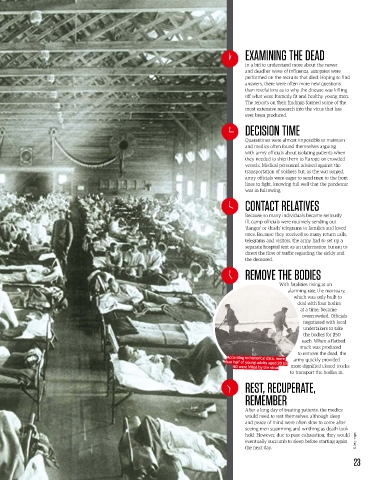
According to historical data, more
army quickly provided
than half of young adults aged 20 to
more dignified closed trucks
40 were killed by the virus
to transport the bodies in.
REST, RECUPERATE,
REMEMBER
After a long day of treating patients, the medics
would need to rest themselves, although sleep
and peace of mind were often slow to come after
seeing men squirming and writhing as death took
hold. However, due to pure exhaustion, they would
eventually succumb to sleep before starting again © Getty Images
the next day.
23

