


Page 44 - All About History - Issue 56-17
P. 44
Empire of the Sun King


               Louis then enacted a programme of   Fouquet, the seemingly all-powerful superintendent   Fouquet was arrested and subjected to a sham
            reform that initially appeared to give the   of finances. Ambitious, arrogant and immensely   trial that was intended to appease Louis. Though
          disenfranchised people who lived on those   wealthy, he enjoyed huge popularity among the   the unfair treatment he received eventually
        feudal lands the changes they sought. Heavily   nobility. When Mazarin died, Fouquet expected to   outraged French society, the message was clear:
        taxed and exploited, they hoped that reforms   take his old colleague’s place beside the king, but   nobody was above the king, no matter what their
        would lessen their burden, but that particular   he had not reckoned on Louis’ own ambition. The   office. For the French nobility, the old order was
        change took decades. Instead, Louis XIV was   monarch had a point to make and Fouquet would be   about to be swept away.
        remoulding the French monarchy as the very   the new regime’s first casualty.    Louis replaced Fouquet with Jean-Baptiste
        model of absolutism.                     In a country facing financial ruin, Fouquet lived a   Colbert, a trusted advisor upon whom he could rely.
                                                life of unrestrained extravagance with close ties to   Under the king’s direction, the unpopular land tax
        The sun rises                           the wealthy tax-farmers who were responsible for   was overhauled. Collectors had to keep records for
                                                                                       the first time and the practice of selling the rights
                                                collecting duty across France. For this reason, Louis
        Louis inherited an administration that was teetering   had to handle him with care. But the king knew   to tax collection via private deals was ended in
        dangerously on the brink of bankruptcy. Presiding   that if he could bring down Fouquet, it would send   favour of a new public auction system. The results
        over this disastrous bank balance was Nicolas   a message to the rest of the aristocracy.  were phenomenally successful, with treasury

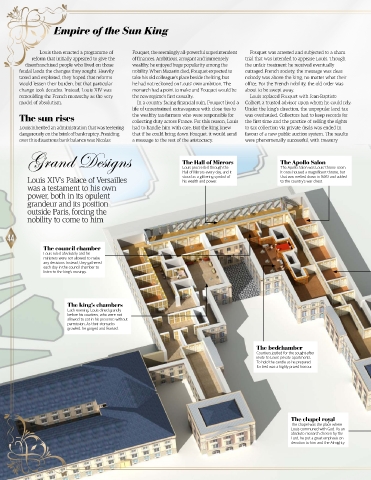
           Grand Designs                                         The Hall of Mirrors                The Apollo Salon

                                                                 Louis proceeded through the        The Apollo Salon was Louis’ throne room.
                                                                 Hall of Mirrors every day, and it   It once housed a magnificent throne, but
                                                                 stood as a glittering symbol of    that was melted down in 1689 and added
           Louis XIV’s Palace of Versailles                      his wealth and power.              to the country’s war chest.
           was a testament to his own
           power, both in its opulent
           grandeur and its position
           outside Paris, forcing the
           nobility to come to him

    44

                The council chamber
                Louis ruled absolutely and his
                ministers were not allowed to make
                any decisions. Instead, they gathered
                each day in the council chamber to
                listen to the king’s musings.


                         The king’s chambers
                         Each evening, Louis dined grandly
                         before his courtiers, who were not
                         allowed to eat in his presence without
                         permission. As their stomachs
                         growled, he gorged and feasted.


                                                                                           The bedchamber
                                                                                           Courtiers jostled for the sought-after
                                                                                           invite to Louis’ private apartments.
                                                                                           To hold the candle as he prepared
                                                                                           for bed was a highly prized honour.


                                                                                                       The chapel royal
                                                                                                       The chapel was the place where
                                                                                                       Louis communed with God. As an
                                                                                                       absolute monarch chosen by the
                                                                                                       Lord, he put a great emphasis on
                                                                                                       devotion to him and the Almighty.

