


Page 48 - All About History - Issue 56-17
P. 48
Through History


             BOATS AND SHIPS


              From the ark to the Ark Royal, humans have been designing vessels for
                thousands of years — and some have changed the course of history


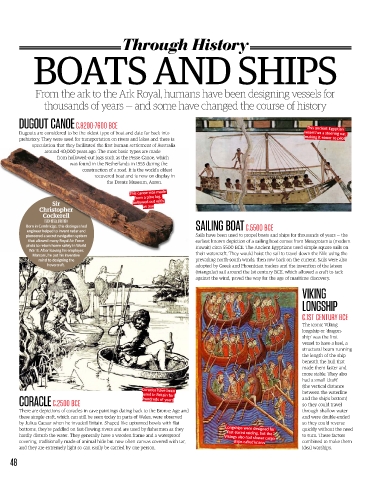
        Dugout     Canoe c.8200-7600 BcE
                                                                                                             This ancient Egyptian
        Dugouts are considered to be the oldest type of boat and date far back into                         vessel has a steering oar,
        prehistory. They were used for transportation on rivers and lakes and there is                      making it easier to pilot
            speculation that they facilitated the first human settlement of Australia
                 around 40,000 years ago. The most basic types are made
                     from hollowed-out logs such as the Pesse Canoe, which
                          was found in the Netherlands in 1955 during the
                              construction of a road. It is the world’s oldest
                                  recovered boat and is now on display in
                                       the Drents Museum, Assen.
                                               This canoe was made
                                                from a pine log,
                   Sir                          hollowed out with
               Christopher                         an axe
                Cockerell
                 1910-1999, British
          Born in Cambridge, this distinguished                       sailing   Boat c.5500 BcE
          engineer helped to invent radar and
          pioneered a secret navigation system                        Sails have been used to propel boats and ships for thousands of years — the
           that allowed many Royal Air Force                          earliest known depiction of a sailing boat comes from Mesopotamia (modern
          pilots to return home safely in World                       Kuwait) circa 5500 BCE. The Ancient Egyptians used simple square sails on
           War II. After leaving his employer,
            Marconi, he put his inventive                             their watercraft. They would hoist the sail to travel down the Nile using the
               mind to designing the                                  prevailing north-south winds, then row back on the current. Sails were also
                  hovercraft.                                         adopted by Greek and Phoenician traders and the invention of the lateen
                                                                      (triangular) sail around the 1st century BCE, which allowed a craft to tack
                                                                      against the wind, paved the way for the age of maritime discovery.

                                                                                                           Viking

                                                                                                           longship

                                                                                                           c.1st cEntury BcE
                                                                                                           The iconic Viking
                                                                                                           longship or ‘dragon-
                                                                                                           ship’ was the first
                                                                                                           vessel to have a keel, a
                                                                                                           structural beam running
                                                                                                           the length of the ship
                                                                                                           beneath the hull that
                                                                                                           made them faster and
                                                                                                           more stable. They also
                                                                                                           had a small ‘draft’
                                                                                                           (the vertical distance
                                                   Coracles have been
                                                                                                           between the waterline
                                                   used in Britain for
                                                                                                           and the ship’s bottom)
                                                   hundreds of years
        CoraCle c.2500 BcE                                                                                 so they could travel
        There are depictions of coracles in cave paintings dating back to the Bronze Age and               through shallow water
        these simple craft, which can still be seen today in parts of Wales, were observed                 and were double-ended
        by Julius Caesar when he invaded Britain. Shaped like upturned bowls with flat                     so they could reverse
        bottoms, they’re paddled on fast-flowing rivers and are used by fishermen as they   Longships were designed for   quickly without the need
                                                                                 fast-paced raiding, but the
        hardly disturb the water. They generally have a wooden frame and a waterproof                      to turn. These factors
                                                                                Vikings also had slower cargo
        covering, traditionally made of animal hide but now often canvas covered with tar,   ships called knarrs  combined to make them
        and they are extremely light so can easily be carried by one person.                               ideal warships.
     48

