


Page 49 - All About History - Issue 56-17
P. 49
Through History


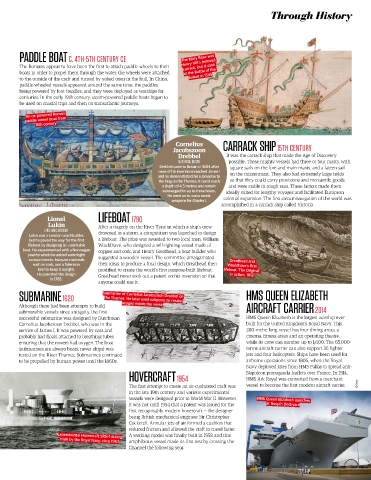
        paDDle    Boat c. 4th-5th cEntury cE                     The Mary Rose was

                                                                 carrack, but it sank
        The Romans appear to have been the first to attach paddle wheels to their   Henry VIII’s beloved
        boats in order to propel them through the water; the wheels were attached   at the Battle of the
        to the outside of the craft and turned by yoked oxen in the hull. In China,   Solent in 1545
        paddle-wheeled vessels appeared around the same time, the paddles
        being powered by foot treadles, and they were deployed as warships for
        centuries. In the early 19th century, steam-powered paddle boats began to
        be used on coastal trips and then on transatlantic journeys.
          An ox-powered Roman
          paddle wheel boat from
              15th century


                                                               Cornelius       CarraCk
                                                              Jacobszoon                    ship 15th cEntury
                                                                Drebbel          It was the carrack ship that made the Age of Discovery
                                                                1572-1633, DutCh  possible. These mighty vessels had three or four masts, with
                                                         Drebbel came to Britain in 1604 after   square sails on the fore and main masts, and a lateen sail
                                                         news of his inventions reached James I
                                                         and he demonstrated his submarine to   on the mizzenmast. They also had extremely large holds
                                                         the king on the Thames. It could reach   so that they could carry provisions and mercantile goods
                                                          a depth of 4.5 metres and remain   and were stable in rough seas. These factors made them
                                                          submerged for up to three hours.   ideally suited for lengthy voyages and facilitated European
                                                            He went on to make secret
                                                             weapons for Charles I.  colonial expansion. The first circumnavigation of the world was
                                                                               accomplished in a carrack ship called Victoria.
                  Lionel            lifeBoat 1790
                  Lukin             After a tragedy on the River Tyne in which a ship’s crew
                 1742-1834, British
           Lukin was a London coachbuilder,   drowned in a storm, a competition was launched to design
           but he paved the way for the first   a lifeboat. The prize was awarded to two local men, William
           lifeboat by designing an unsinkable   Wouldhave, who designed a self-righting vessel made of
         boat. He experimented with a Norwegian   copper and cork, and Henry Greathead, a boat builder who
           yawl to which he added watertight
           compartments, buoyant materials   suggested a wooden vessel. The committee amalgamated   Greathead and
             such as cork, and a false iron    their ideas to produce a final design, which Greathead then   Wouldhave’s first
              keel to keep it upright.    modified to create the world’s first purpose-built lifeboat.   lifeboat ‘The Original’
              He patented the design   Greathead never took out a patent on his invention so that   in action, 1813
                   in 1785.
                                    anyone could use it.
        suBmarine 1620               Submarine of Cornelius Jacobszoon Drebbel on       hms   Queen    elizaBeth
                                      the Thames. He later used saltpetre to create
                                            oxygen inside the vessel
        Although there had been attempts to build                                       airCraft
        submersible vessels since antiquity, the first                                               Carrier 2014
        successful submarine was designed by Dutchman                                   HMS Queen Elizabeth is the largest warship ever
        Cornelius Jacobszoon Drebbel, who was in the                                    built for the United Kingdom’s Royal Navy. This
        service of James I. It was powered by oars and                                  280-metre long vessel has four dining areas, a
        probably had floats attached to breathing tubes                                 cinema, fitness areas and an operating theatre,
        ensuring that the rowers had oxygen. The boat                                   while its crew can number up to 1,600. The 65,000-
        (submarines are always boats, never ships) was                                  tonne aircraft carrier can also support 36 fighter
        tested on the River Thames. Submarines continued                                jets and four helicopters. Ships have been used for
        to be propelled by human power until the 1860s.                                 airborne operations since 1806, when the Royal
                                                                                        Navy deployed kites from HMS Pallas to spread anti-
                                                                                        Napoleon propaganda leaflets over France. In 1914,
                                              hoVerCraft 1954                           HMS Ark Royal was converted from a merchant
                                              The first attempt to create an air-cushioned craft was   vessel to become the first modern aircraft carrier.  © Getty
                                              in the late 19th century and various experimental
                                              vessels were designed prior to World War II. However,   HMS Queen Elizabeth launches
                                              it was not until 1954 that a patent was issued for the   at Rosyth Dockyard
                                              first recognisably modern hovercraft — the designer
                                              being British mechanical engineer Sir Christopher
                                              Cockerell. Annular jets of air formed a cushion that
                                              reduced friction and allowed the craft to travel faster.
                                              A working model was finally built in 1958 and this
                     Experimental Hovercraft SRN-1 during
                                              amphibious vessel made its first test by crossing the
                      trials by the Royal Navy, circa 1963
                                              Channel the following year.
                                                                                                                             49

