


Page 79 - All About History - Issue 56-17
P. 79
Graffiti through the Ages


        Romans Go Home
        In the 1979 Monty Python film The Life of Brian, the   “Celadus the Thracian gladiator is the delight of all   held up so much tedious graffiti that I am amazed
        protagonist is given the unpleasant task of trying to   the girls.” Other writings are simply unprintable in   that you have not already collapsed in ruin.”
        correctly conjugate the phrase ‘Romans go home!’   translation due to their explicit vividness.   Interestingly, one of the earliest known and
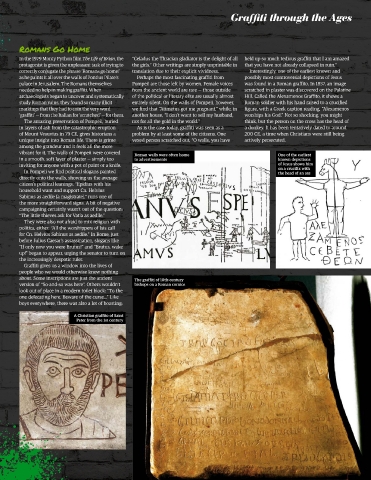
        as he paints it all over the walls of Pontius Pilate’s   Perhaps the most fascinating graffiti from   possibly most controversial depictions of Jesus
        palace in Jerusalem. The Romans themselves   Pompeii are those left by women. Female voices   was found in a Roman graffito. In 1857, an image
        needed no help in making graffiti. When   from the ancient world are rare — those outside   scratched in plaster was discovered on the Palatine
        archaeologists began to uncover and systematically   of the political or literary elite are usually almost   Hill. Called the Alexamenos Graffito, it shows a
        study Roman ruins, they found so many illicit   entirely silent. On the walls of Pompeii, however,   Roman soldier with his hand raised to a crucified
        markings that they had to coin the very word   we find that “Atimetus got me pregnant,” while, in   figure, with a Greek caption reading, “Alexamenos
        ‘graffiti’ — from the Italian for ‘scratched’ — for them.  another house, “I don’t want to sell my husband,   worships his God.” Not so shocking, you might
          The amazing preservation of Pompeii, buried   not for all the gold in the world.”  think, but the person on the cross has the head of
        in layers of ash from the catastrophic eruption   As is the case today, graffiti was seen as a   a donkey. It has been tentatively dated to around
        of Mount Vesuvius in 79 CE, gives historians a   problem by at least some of the citizens. One   200 CE, a time when Christians were still being
        unique insight into Roman life. There is grime   vexed person scratched out, “O walls, you have   actively persecuted.
        among the grandeur and it feels all the more
        vibrant for it. The walls of Pompeii were covered
                                                Roman walls were often home                        One of the earliest
        in a smooth, soft layer of plaster — simply too   to advertisements                        known depictions
        inviting for anyone with a pot of paint or a knife.                                        of Jesus shows him
                                                                                                   on a crucifix with
          In Pompeii we find political slogans painted                                             the head of an ass
        directly onto the walls, showing us the average
        citizen’s political leanings. “Epidius with his
        household want and support Cn. Helvius
        Sabinus as aedile [a magistrate],” runs one of
        the more straightforward signs. A bit of negative
        campaigning certainly wasn’t out of the question:
        “The little thieves ask for Vatia as aedile.”
          They were also not afraid to mix religion with
        politics, either: “All the worshippers of Isis call
        for Cn. Helvius Sabinus as aedile.” In Rome, just
        before Julius Caesar’s assassination, slogans like
        “If only now you were Brutus!” and “Brutus, wake
        up!” began to appear, urging the senator to turn on
        the increasingly despotic ruler.
          Graffiti gives us a window into the lives of
        people who we would otherwise know nothing
        about. Some inscriptions are just the ancient   The graffiti of 10th-century
        version of “So-and-so was here”. Others wouldn’t   bishops on a Roman cornice
        look out of place in a modern toilet block: “To the
        one defecating here. Beware of the curse...” Like
        boys everywhere, there was also a lot of boasting:

                           A Christian graffito of Saint
                            Peter from the 1st century


                                                                                                                             79

