


Page 83 - All About History - Issue 56-17
P. 83
Graffiti through the Ages


        Modern art
        Graffiti art proper, as opposed to simple written tags,                   Magic marks
        really took off in the 1970s. In 1979, an exhibition in
        a Roman gallery introduced the concept of graffiti                        Graffiti  sometimes  had  ritual  uses.
        as art to the world at large. What had been a societal                    Apotropaic marks are used to ward off evil
        scourge began to turn up in galleries and people                          and have been found in churches, homes
        would pay money to own what they had previously                           and even barns
        scrubbed from their walls.
                                                                                  Solomon’s knot
          Now graffiti is in the eye of the beholder; despite
        the bankability of Banksy, council workers still                          An intricate knot of lines,
        sometimes scour his works from walls, unaware of                          Solomon’s knot has been
        what they are washing down the drain.                                     depicted in Christian, Islamic
          With money comes commercialisation.                                     and Jewish artwork. In
        Companies pay talented graffiti artists to spray their                    Britain, it was believed that
        message far and wide. But even this is no novelty.                        simple-minded demons would
        On the walls of Pompeii, one could find adverts for                       become trapped as they tried
        gladiator shows, brothels and property for rent all                       to follow the lines, rendering
        jostling for space. The human story, it seems, is one                     them harmless.
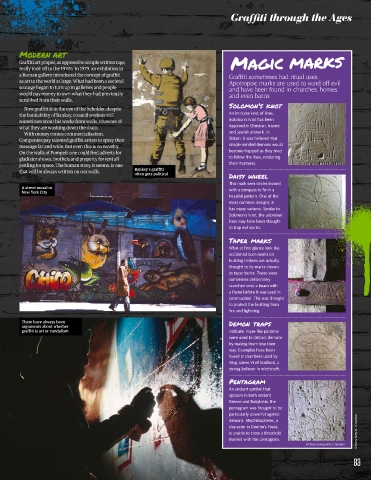
                                                Banksy’s graffiti
        that will be always written on our walls.
                                                often gets political
                                                                                  Daisy  wheel
                                                                                  This mark sees circles incised
         A street mural in                                                        with a compass to form a
         New York City
                                                                                  hexafoil pattern. One of the
                                                                                  most common designs, it
                                                                                  has many variants. Similar to
                                                                                  Solomon’s knot, the unbroken
                                                                                  lines may have been thought
                                                                                  to trap evil spirits.
                                                                                  Taper  marks
                                                                                  What at first glance look like
                                                                                  accidental burn marks on
                                                                                  building timbers are actually
                                                                                  thought to be marks known
                                                                                  as taper burns. These were
                                                                                  sometimes deliberately
                                                                                  scorched onto a beam with
                                                                                  a flame before it was used in
                                                                                  construction. This was thought
                                                                                  to protect the building from
                                                                                  fire and lightning.
         There have always been                                                   Demon   traps
         arguments about whether
         graffiti is art or vandalism                                             Intricate, maze-like patterns
                                                                                  were used to distract demons
                                                                                  by making them lose their
                                                                                  way. Examples have been
                                                                                  found in chambers used by
                                                                                  King James VI of Scotland, a
                                                                                  strong believer in witchcraft.

                                                                                  Pentagram
                                                                                  An ancient symbol that
                                                                                  appears in both ancient
                                                                                  Greece and Babylonia, the
                                                                                  pentagram was thought to be
                                                                                  particularly powerful against
                                                                                  demons. Mephistopheles, a
                                                                                  character in Goethe’s Faust,
                                                                                  is unable to cross a threshold              © Alamy, Getty, M. J. Champion
                                                                                  marked with the pentagram.
                                                                                                             © Photos courtesy of M. J. Champion

                                                                                                                             83

