


Page 80 - All About History - Issue 56-17
P. 80
Graffiti through the Ages


              In the Footsteps of Vikings

             Maeshowe Chambered Cairn on Orkney   served as the personal guard of the Byzantine   guard decided this famous landmark needed some
           is a Neolithic burial chamber that was erected   emperors because they were valued for their ferocity   extra decoration. Both of the lion’s flanks bear
          almost 5,000 years ago. The Orkneyinga Saga   in combat and devout loyalty to their employer.   runes carved in a lindworm, or dragon, pattern.
          tells of how Viking settlers broke into the   They also brought their tendency to vandalise the   Increasingly weathered over the centuries, the
          prehistoric cairn in search of treasure 1,000 years   property of others as well. In the basilica of Hagia   inscriptions are difficult to make out, but translations
          ago and left a trove of runic inscriptions behind   Sophia in Constantinople there are two short runic   have been made:
          them that can still be seen today. Some follow the   graffiti, almost indecipherably worn away, but in   “They cut him down in the midst of his forces.
          pattern of most graffiti — “Ottarfila carved these   Athens a longer inscription was set down.  But in the harbour the men cut runes by the sea in
        runes” — while others make reference to the treasure   At the city’s port of Piraeus, a white marble   memory of Horsi, a good warrior. The Swedes set this
        mentioned in the saga.                 lion statue was set up in the 1st century CE. So   on the lion. He went his way with good counsel, gold
          The Scottish cairn wasn’t an isolated incident.   famous was this lion that the whole port came to   he won in his travels. The warriors cut runes, hewed
        From the 10th to the 14th centuries, Norse soldiers   be known as Porto Leone. At some point, a Norse   them in an ornamental scroll…”


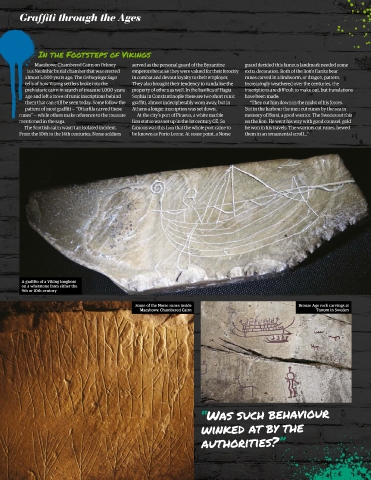
         A grafitto of a Viking longboat
         on a whetstone from either the
         9th or 10th century


                                                 Some of the Norse runes inside                           Bronze Age rock carvings at
                                                  Maeshowe Chambered Cairn                                      Tanum in Sweden


                                                                        “Was such behaviour

                                                                        winked at by the


                                                                        authorities?”


     80

