


Page 84 - (DK Eyewitness) Travel Guide - London
P. 84
82 L ONDON AREA B Y AREA
A Guided Tour of Westminster Abbey
The Abbey’s interior presents an exceptionally diverse array
of architectural and sculptural styles. These range from the
austere French Gothic of the nave to the stunning complexity
of Henry VII’s Tudor chapel and the riotous invention of
the later 18th-century monuments. Many British monarchs
were buried here; some of their tombs are deliberately
plain, while others are lavishly decorated. There are also
monuments to a number of Britain’s greatest public figures –
ranging from politicians to poets – crowded into the aisles
and transepts.
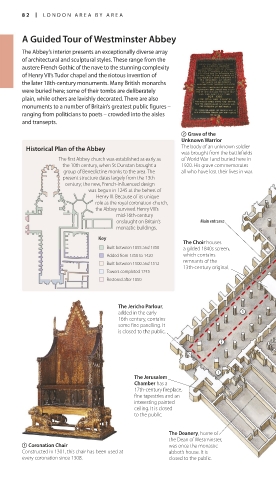
2 Grave of the
Unknown Warrior
Historical Plan of the Abbey The body of an unknown soldier
was brought from the battlefields
The first Abbey church was established as early as of World War I and buried here in
the 10th century, when St Dunstan brought a 1920. His grave commemorates
group of Benedictine monks to the area. The all who have lost their lives in war.
present structure dates largely from the 13th
century; the new, French-influenced design
was begun in 1245 at the behest of
Henry III. Because of its unique
role as the royal coronation church,
the Abbey survived Henry VIII’s
mid-16th-century
onslaught on Britain’s Main entrance
monastic buildings.
Key
The Choir houses
Built between 1055 and 1350 a gilded 1840s screen,
Added from 1350 to 1420 which contains
Built between 1500 and 1512 remnants of the
13th-century original.
Towers completed 1745
Restored after 1850
The Jericho Parlour,
added in the early
16th century, contains
some fine panelling. It
is closed to the public.
The Jerusalem
Chamber has a
17th-century fireplace,
fine tapestries and an
interesting painted
ceiling. It is closed
to the public.
The Deanery, home of
the Dean of Westminster,
1 Coronation Chair was once the monastic
Constructed in 1301, this chair has been used at abbot’s house. It is
every coronation since 1308. closed to the public.
082-083_EW_London.indd 82 21/03/17 2:20 pm

