


Page 86 - (DK Eyewitness) Travel Guide - London
P. 86
84 L ONDON AREA B Y AREA
q Banqueting played the precursor of modern
House lawn tennis. On the opposite
side, the view is dominated by
Whitehall SW1. Map 13 B4. Tel 0844 the ivy-covered Citadel. This is a
482 7777; to check possible closures bomb-proof structure that was
call 020 3166 6154). 1 Charing Cross, erected in 1940 beside the
Embankment, Westminster. Admiralty. During World War II,
Open 10am–5pm daily (last adm
4:15pm). Closed public hols, it was used as a communications
22 Dec–1 Jan; may close early for headquarters by the Navy.
functions (see above). & 7 Mon–Fri
only. 9 = ∑ hrp.org.uk
e Household
This delightful building is of Cavalry Museum
great architectural importance.
It was the first in central London Horse Guards, Whitehall SW1. Map
to embody the Classical Palladian 13 B4. Tel 020 7930 3070. 1 West-
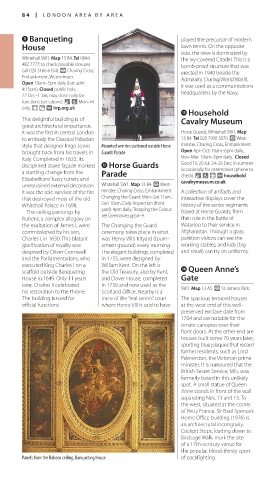
style that designer Inigo Jones Mounted sentries stationed outside Horse minster, Charing Cross, Embankment.
brought back from his travels in Guards Parade Open Apr–Oct: 10am–6pm daily,
Italy. Completed in 1622, its Nov–Mar: 10am–5pm daily. Closed
disciplined stone façade marked w Horse Guards Good Fri, 20 Jul, 24–26 Dec; in summer
occasionally for ceremonies (phone to
a startling change from the Parade check). & 7 9 ∑ household
Elizabethans’ fussy turrets and cavalrymuseum.co.uk
unrestrained external decoration. Whitehall SW1. Map 13 B4. 1 West-
It was the sole survivor of the fire minster, Charing Cross, Embankment. A collection of artifacts and
that destroyed most of the old Changing the Guard: Mon–Sat 11am, interactive displays cover the
Whitehall Palace in 1698. Sun 10am. Daily inspection (front history of the senior regiments
yard): 4pm daily. Trooping the Colour:
The ceiling paintings by see Ceremonies pp56–9. based at Horse Guards, from
Rubens, a complex allegory on their role in the Battle of
the exaltation of James I, were The Changing the Guard Waterloo to their service in
commissioned by his son, ceremony takes place in what Afghanistan. Through a glass
Charles I, in 1630. This blatant was Henry VIII’s tiltyard (tourn- partition visitors can see the
glorification of royalty was ament ground) every morning. working stables, and kids (big
despised by Oliver Cromwell The elegant buildings, completed and small) can try on uniforms.
and the Parliamentarians, who in 1755, were designed by
executed King Charles I on a William Kent. On the left is r Queen Anne’s
scaffold outside Banqueting the Old Treasury, also by Kent,
House in 1649. Only 11 years and Dover House, completed Gate
later, Charles II celebrated in 1758 and now used as the SW1. Map 13 A5. 1 St James’s Park.
his restoration to the throne. Scotland Office. Nearby is a
The building is used for trace of the “real tennis” court The spacious terraced houses
official functions. where Henry VIII is said to have at the west end of this well-
preserved enclave date from
1704 and are notable for the
ornate canopies over their
front doors. At the other end are
houses built some 70 years later,
sporting blue plaques that record
former residents, such as Lord
Palmerston, the Victorian prime
minister. It is rumoured that the
British Secret Service, MI5, was
formerly based in this unlikely
spot. A small statue of Queen
Anne stands in front of the wall
separating Nos. 13 and 15. To
the west, situated at the corner
of Petty France, Sir Basil Spence’s
Home Office building (1976) is
an architectural incongruity.
Cockpit Steps, leading down to
Birdcage Walk, mark the site
of a 17th-century venue for
the popular, blood-thirsty sport
Panels from the Rubens ceiling, Banqueting House of cockfighting.
084-085_EW_London.indd 84 21/03/17 2:20 pm

