


Page 113 - Inventions - A Visual Encyclopedia (DK - Smithsonian)
P. 113
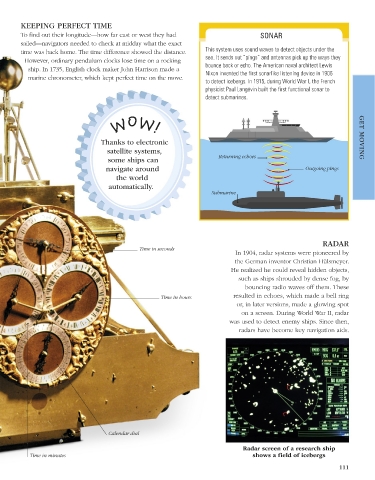
KEEPING PERFECT TIME
        To find out their longitude—how far east or west they had                     SONAR
        sailed—navigators needed to check at midday what the exact
        time was back home. The time difference showed the distance.   This system uses sound waves to detect objects under the
         However, ordinary pendulum clocks lose time on a rocking   sea. It sends out “pings” and antennas pick up the ways they
          ship. In 1735, English clock maker John Harrison made a   bounce back or echo. The American naval architect Lewis
                                                                    Nixon invented the first sonarlike listening device in 1906
          marine chronometer, which kept perfect time on the move.
                                                                    to detect icebergs. In 1915, during World War I, the French
                                                                    physicist Paul Langévin built the first functional sonar to
                                                                    detect submarines.


                                      WOW!


                                  Thanks to electronic                                                                 GET MOVING
                                    satellite systems,
                                    some ships can                      Returning echoes
                                    navigate around                                                  Outgoing pings
                                       the world
                                    automatically.
                                                                      Submarine


                                                                                                          RADAR
                                               Time in seconds
                                                                              In 1904, radar systems were pioneered by
                                                                              the German inventor Christian Hülsmeyer.
                                                                             He realized he could reveal hidden objects,
                                                                               such as ships shrouded by dense fog, by
                                                                                 bouncing radio waves off them. These
                                                      Time in hours          resulted in echoes, which made a bell ring
                                                                              or, in later versions, made a glowing spot
                                                                                on a screen. During World War II, radar
                                                                            was used to detect enemy ships. Since then,
                                                                               radars have become key navigation aids.


                                    Calendar dial

                                                                                Radar screen of a research ship
           Time in minutes                                                          shows a field of icebergs
                                                                                                                111


   US_110-111_Navigating_at_sea_Main.indd   111                                                                  08/03/18   3:09 PM

