


Page 138 - Inventions - A Visual Encyclopedia (DK - Smithsonian)
P. 138
The


          telegraph                                                     the movable arm
                                                                          The position of
                                                                       represents different
                                                                      letters and numbers.
          In 1820, Hans Christian Ørsted discovered

          that electricity could create magnetism.
      COMMUNICATION  developed the electromagnet—in which an
          From this, William Sturgeon and Joseph Henry


          electric current creates a strong magnetic field.

          In turn, this led Samuel Morse to resume his
          experiments in electricity and, eventually, a

          new way of communicating was born.


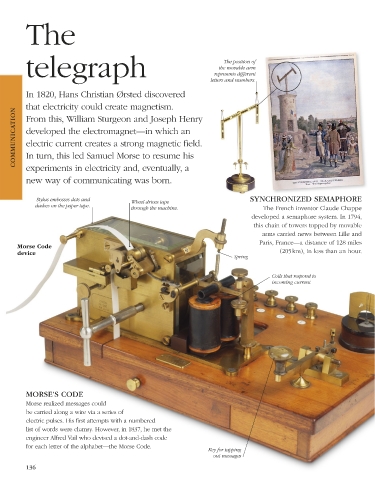
             Stylus embosses dots and       Wheel drives tape                      SYNCHRONIZED SEMAPHORE
            dashes on the paper tape.       through the machine.                       The French inventor Claude Chappe

                                                                                   developed a semaphore system. In 1794,
                                                                                    this chain of towers topped by movable
                                                                                       arms carried news between Lille and
                                                                                      Paris, France—a distance of 128 miles
       Morse Code
       device                                                                               (205 km), in less than an hour.
                                                                             Spring


                                                                                          Coils that respond to
                                                                                          incoming current


          MORSE’S CODE

          Morse realized messages could
          be carried along a wire via a series of
          electric pulses. His first attempts with a numbered
          list of words were clumsy. However, in 1837, he met the
          engineer Alfred Vail who devised a dot-and-dash code
          for each letter of the alphabet—the Morse Code.
                                                                     Key for tapping
                                                                       out messages
          136


   US_136-137_308121_Telegraph.indd   136                                                                        09/03/2018   14:32

