


Page 142 - Inventions - A Visual Encyclopedia (DK - Smithsonian)
P. 142
Telling the time


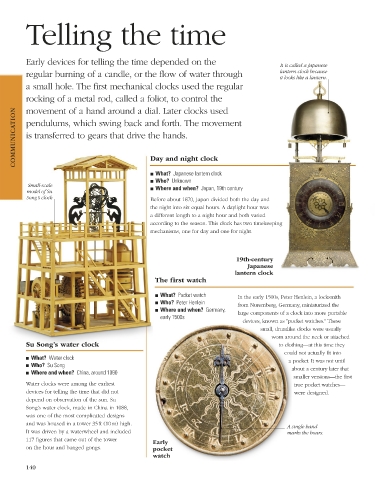
          Early devices for telling the time depended on the
                                                                                             It is called a Japanese
          regular burning of a candle, or the flow of water through                         lantern clock because
                                                                                            it looks like a lantern.
          a small hole. The first mechanical clocks used the regular
          rocking of a metal rod, called a foliot, to control the

          movement of a hand around a dial. Later clocks used
      COMMUNICATION  pendulums, which swing back and forth. The movement


          is transferred to gears that drive the hands.


                                                  Day and night clock

                                                  ■   What?  Japanese lantern clock
                                                  ■   Who?  Unknown
          Small-scale                                Where and when?  Japan, 19th century
          model of Su                             ■
          Song’s clock                            Before about 1870, Japan divided both the day and
                                                  the night into six equal hours. A daylight hour was
                                                  a different length to a night hour and both varied
                                                  according to the season. This clock has two timekeeping
                                                  mechanisms, one for day and one for night.


                                                                              19th-century
                                                                                  Japanese
                                                                              lantern clock
                                                    The first watch


                                                    ■   What?  Pocket watch    In the early 1500s, Peter Henlein, a locksmith
                                                    ■   Who?  Peter Henlein    from Nuremberg, Germany, miniaturized the
                                                    ■   Where and when?  Germany,    large components of a clock into more portable
                                                      early 1500s
                                                                                devices, known as “pocket watches.” These
                                                                                      small, drumlike clocks were usually
                                                                                          worn around the neck or attached
          Su Song’s water clock                                                             to clothing—at this time they
                                                                                              could not actually fit into
          ■   What?  Water clock                                                               a pocket. It was not until
          ■   Who?  Su Song                                                                     about a century later that
          ■   Where and when?  China, around 1090
                                                                                                 smaller versions—the first
          Water clocks were among the earliest                                                   true pocket watches—
          devices for telling the time that did not                                              were designed.
          depend on observation of the sun. Su
          Song’s water clock, made in China in 1088,
          was one of the most complicated designs
          and was housed in a tower 35 ft (10 m) high.                                         A single hand
          It was driven by a waterwheel and included                                           marks the hours.
          117 figures that came out of the tower    Early
          on the hour and banged gongs.            pocket
                                                   watch
          140


   US_140-141_30812_Clocks_gallery.indd   140                                                                    26/03/2018   11:32

