


Page 139 - Inventions - A Visual Encyclopedia (DK - Smithsonian)
P. 139
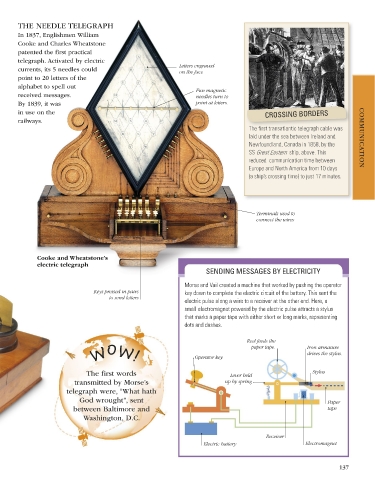
THE NEEDLE TELEGRAPH
       In 1837, Englishmen William
       Cooke and Charles Wheatstone
       patented the first practical
       telegraph. Activated by electric
       currents, its 5 needles could                        Letters engraved
                                                            on the face
       point to 20 letters of the
       alphabet to spell out
                                                                 Five magnetic
       received messages.                                        needles turn to
       By 1839, it was                                           point at letters.
       in use on the                                                                    CROSSING BORDERS
       railways.
                                                                                  The first transatlantic telegraph cable was
                                                                                  laid under the sea between Ireland and   COMMUNICATION
                                                                                  Newfoundland, Canada in 1858, by the
                                                                                  SS Great Eastern  ship, above. This
                                                                                  reduced  communication time between
                                                                                  Europe and North America from 10 days
                                                                                  (a ship’s crossing time) to just 17 minutes.


                                                                                     Terminals used to
                                                                                     connect the wires


             Cooke and Wheatstone’s
             electric telegraph
                                                                    SENDING MESSAGES BY ELECTRICITY

                                                             Morse and Vail created a machine that worked by pushing the operator
                                Keys pressed in pairs        key down to complete the electric circuit of the battery. This sent the
                                     to send letters
                                                             electric pulse along a wire to a receiver at the other end. Here, a
                                                             small electromagnet powered by the electric pulse attracts a stylus
                                                             that marks a paper tape with either short or long marks, representing
                                                             dots and dashes.


                                                                                  Reel feeds the
                                                                                   paper tape.       Iron armature
                               WOW!                              Operator key                        drives the stylus.


                             The first words                                Lever held                 Stylus
                         transmitted by Morse’s                           up by spring
                       telegraph were, “What hath
                           God wrought”, sent                                                               Paper
                         between Baltimore and                                                              tape
                            Washington, D.C.


                                                                                        Receiver
                                                                   Electric battery                  Electromagnet


                                                                                                                137


   US_136-137_308121_Telegraph.indd   137                                                                        09/03/2018   15:25

