


Page 140 - Inventions - A Visual Encyclopedia (DK - Smithsonian)
P. 140
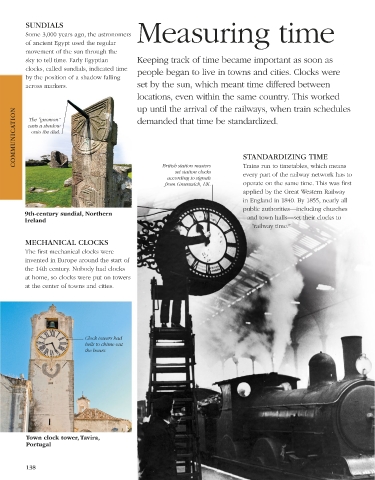
SUNDIALS
         Some 3,000 years ago, the astronomers  Measuring time
         of ancient Egypt used the regular
         movement of the sun through the
         sky to tell time. Early Egyptian     Keeping track of time became important as soon as
         clocks, called sundials, indicated time   people began to live in towns and cities. Clocks were
         by the position of a shadow falling
         across markers.                      set by the sun, which meant time differed between
                                              locations, even within the same country. This worked
                                              up until the arrival of the railways, when train schedules
      COMMUNICATION  casts a shadow
                                              demanded that time be standardized.
          The “gnomon”
           onto the dial.


                                                                                Trains run to timetables, which means
                                                      British station masters
                                                          set station clocks    STANDARDIZING TIME
                                                                                every part of the railway network has to
                                                        according to signals
                                                       from Greenwich, UK.      operate on the same time. This was first
                                                                                applied by the Great Western Railway
                                                                                in England in 1840. By 1855, nearly all
                                                                                public authorities—including churches
         9th-century sundial, Northern
         Ireland                                                                  and town halls—set their clocks to
                                                                                   “railway time.”

         MECHANICAL CLOCKS
         The first mechanical clocks were
         invented in Europe around the start of
         the 14th century. Nobody had clocks
         at home, so clocks were put on towers
         at the center of towns and cities.


                             Clock towers had
                             bells to chime out
                             the hours.


          Town clock tower, Tavira,
          Portugal


          138


   US_138-139_308121_Measuring_Time.indd   138                                                                   08/03/2018   17:17

