


Page 153 - Inventions - A Visual Encyclopedia (DK - Smithsonian)
P. 153
DEVELOPMENT OF RADIO
        Early transmitters could send out radio waves only
        in short bursts and used Morse code. For proper
 WOW!   sound, continuous waves are needed. In 1906,
        Canadian-American engineer Reginald Fessenden
        invented an electric generator that could produce
        such waves. His first broadcast was on Christmas
        Eve, 1906. Regular broadcasting began in 1909, but
        it was not widely used until after World War I.
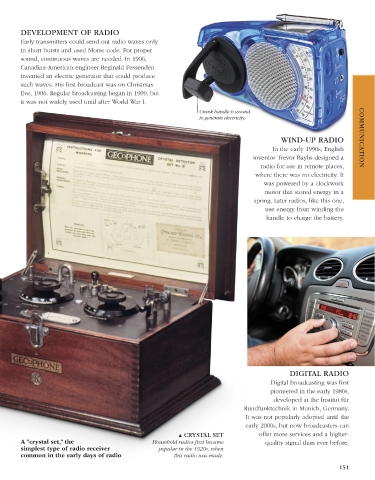
                                                                  Crank handle is wound
                                                                  to generate electricity.


                                                                                             WIND-UP RADIO             COMMUNICATION
                                                                                          In the early 1990s, English
                                                                                    inventor Trevor Baylis designed a
                                                                                      radio for use in remote places,
                                                                                    where there was no electricity. It
                                                                                       was powered by a clockwork
                                                                                       motor that stored energy in a
                                                                                    spring. Later radios, like this one,
                                                                                        use energy from winding the
                                                                                        handle to charge the battery.


                                                                                                DIGITAL RADIO
                                                                                         Digital broadcasting was first
                                                                                         pioneered in the early 1980s,
                                                                                          developed at the Institut für
                                                                                 Rundfunktechnik in Munich, Germany.
                                                                                 It was not popularly adopted until the
                                                                                 early 2000s, but now broadcasters can
                                                           ▲ CRYSTAL SET              offer more services and a higher-
        A “crystal set,” the                       Household radios first became        quality signal than ever before.
        simplest type of radio receiver              popular in the 1920s, when
        common in the early days of radio                 this radio was made.
                                                                                                                151


   US_150-151_308121_Radio_main.indd   151                                                                       08/03/2018   17:17

